

The United Kingdom’s cathedrals are usually centuries old; their architecture grand, their spires soaring, their furnishings elaborate. But these are not the features that remain with me after I visit one of these centres of Christian worship. I tend to remember quirks and connections, especially connections to books.
In this occasional series on UK cathedrals, I share the memories that linger long after my visits. From St Magnus Cathedral on Orkney Mainland, it is the story of Earl Magnus Erlendson, the man behind the cathedral’s name; in particular, the Icelandic saga that records his history and the book that offers a fictional version of his life.
Website: St Magnus Cathedral
Name: St Magnus Cathedral, also known as the ‘Light of the North’
Date: building, using local red and yellow sandstone, commenced in 1137
Location: Broad Street, Kirkwall, Orkney KW15 1DH
Architecture: Romanesque, with Gothic and Roman elements
Café: light refreshments available in the St Magnus Centre, open from April to September
Tours: Yes (booking required, cost involved) ; also, a free, in-house app providing an audio-visual guide
Admission charge: no (donations welcome)
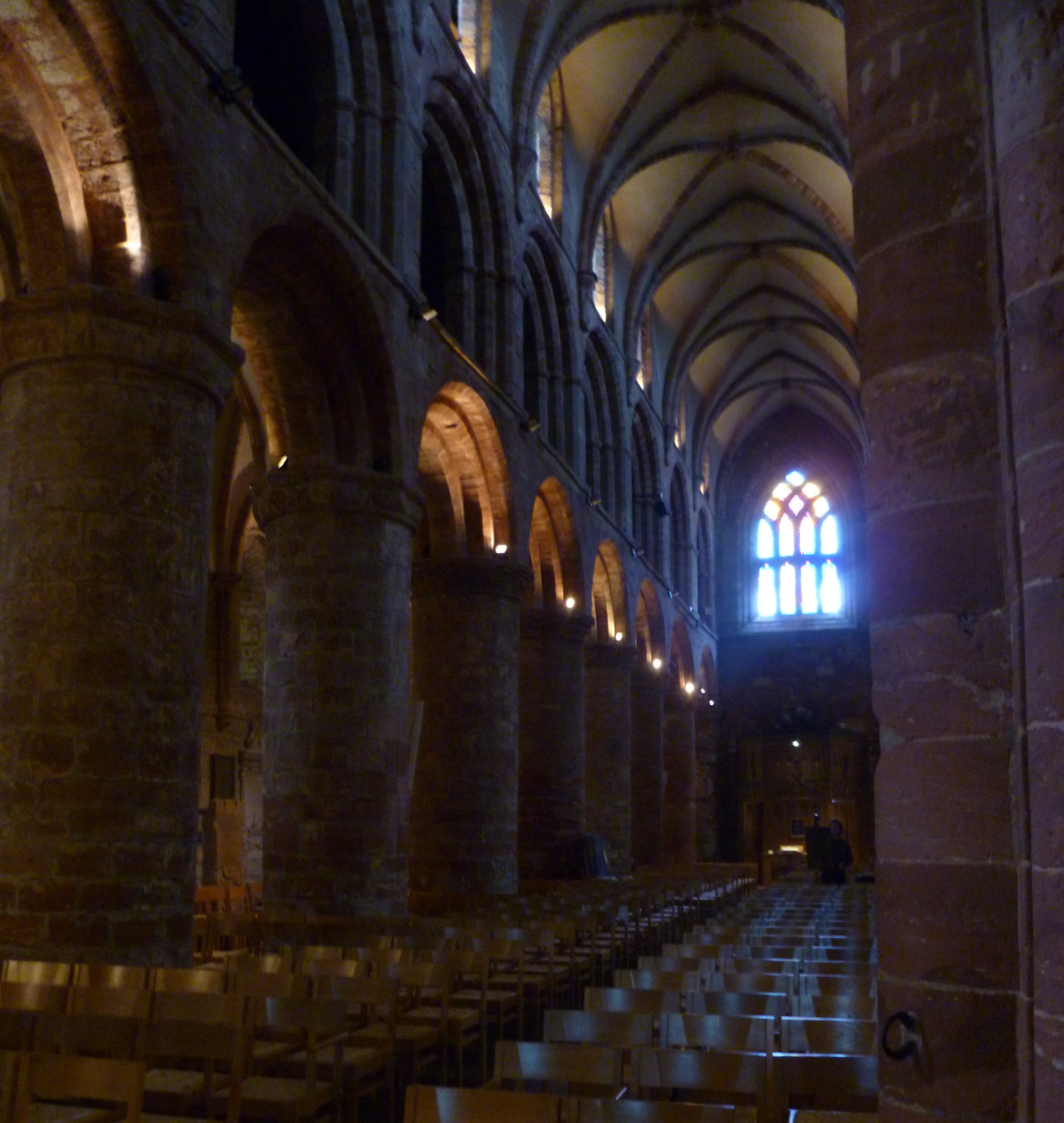
Orkneyinga Saga

The Orkneyinga Saga, a composite of fact and fable, traces the lives of Orkney’s earls from the ninth to the thirteenth century. The Saga, originally written in Old Norse by an Icelander, was first translated into English in 1873 in a publication edited by John Anderson, the Keeper of the National Museum of the Antiquaries of Scotland.
The life of Magnus Erlendson (c.1080-1117) is one of the stories recorded in the Saga. Magnus and his cousin Hakon Paulson were grandsons of Earl Thorfinn Sigdurdon. Thorfinn’s sons, Earl Paul Thorfinnson (father of Paulson) and Earl Erlend Thorfinnson (father of Magnus) governed the Orkney Islands jointly. Their sons were destined to do likewise.
Magnus’s appearance in the Saga begins when he and Hakon are seized by Norway’s King Magnus (known as Magnus Barelegs) and taken on a raiding mission to Wales. Magnus refuses to fight. Instead, he takes his psalter and quietly sings the psalms during the battle.
The first threads of Magnus’s sanctified cloak are spun into folklore. His reputation for piety and holiness grows.
In time, Magnus and Hakon assume the joint governance of the Orkney Islands. After a period of stability, fractures emerge and, as the Saga puts it, ‘men of evil dispositions were found who destroyed their good understanding.’
To flesh out the story’s climax, let’s turn to George Mackay Brown’s version of events.
George Mackay Brown’s Magnus

One hundred years after the appearance of the first English translation of the Orkneyinga Saga, Orcadian George Mackay Brown (1921-1996) published his novel Magnus.
In the Beginning…
Brown begins his tale at Birsay, on the west coast of Orkney Mainland. He grounds his story of Magnus’s life in the land and its people – the tilling of the earth, the changing of the seasons, the crofters, the tinkers, the bishops, the earls. Then he brings his main players to the stage – a collection of seven-year-old boys walking across the tidal flats from Birsay to the offshore Brough to begin two years of formal education at the monastery. Among them, Magnus and his cousin Hakon.

The arrival of the boys interrupts Bishop William of Orkney who is writing to his counterpart in Norway. William is concerned that Earl Thorfinn’s life is nearing its end. He reflects:
‘Such is the flaw at the heart of all human skill and endeavour … that the most important law of all, that concerning inheritance, makes every death-bed in our part of the world a place of wrangling and dread.’
‘Everywhere’, William continues, ‘the past bequeaths to the present a mutilated inheritance.’ And so it proved to be.
The Temptations of Magnus
Brown moves his narrative on through Magnus and Hakon’s sea voyage with King Magnus and into the period where the cousins gain their ‘mutilated inheritance’. As the Tempter who regularly visits Magnus puts it:
‘It’s the old sorry tale – two earls, one small domain, a sundered allegiance. There was bound to be trouble.’
And trouble there is. Hostilities break out between the factions loyal to Hakon and those devoted to Magnus. In one of his visitations, the Tempter cautions: ‘There may be worse to come – civil war, mercenaries riding through the cornfields. Murder. Burning. Rape. You have lost control of the situation.’ The Tempter offers Magnus the chance to withdraw and enter a monastery but earl will not relinquish his title.
It is then that the five boys from Magnus and Hakon’s childhood, now representatives of the two earls, devise a plan. They will bring the warring leaders together on Easter Monday on the island of Egilsay. But first, the five return to the site of their childhood education to call on Bishop William.
‘We are going to force peace on the two earls’, they tell the bishop, inviting his attendance at the gathering. The old bishop declines:
‘You can’t force peace on a situation. All you can do is hold the door open and invite peace to enter.’
The Peace Meeting
The peace meeting is arranged but foul play is afoot. Despite agreeing to only two ships for each party, Hakon arrives with eight. To tell what happens next, Brown flips his narrative’s point of view. Instead of using 11th-century witnesses, the story is told in the form of a 20th-century news report.
The opposing parties come together. It is acknowledged that Magnus is ‘not a ruler by vocation but only the accidents of blood and inheritance’ whereas Hakon is ‘a man dedicated and devoted to the art of government’. When the talks break down, Hakon decides the only solution is the death of Magnus. He appoints his cook Lifolf – ‘a butcher, an ordinary tradesman who chopped meat and bones with a certain practiced skill’ – as the man for the job.
The Sacrifice
‘At certain times and in certain places men still crave spectacular sacrifice.’
Now Brown is ready to tell the tale of Magnus’s execution and he switches perspective again. This time he transfers the setting to a compound where Lifolf is the chef (with ‘a Jewish boy called Rudi’ as one of his orderlies) and where new prisoners are arriving daily. They come in cattle trucks, ‘men, women and children, thousands of them’.
Lifolf is summoned by the camp commandant and taken to a cellar block, ‘known only to a few’. The nature of his task is explained; a task which, ‘for any true German’, would be ‘a great honour’. A man will be stood on a stool with a ‘noose about his throat’. Lifolf’s job is simply to ‘pull the stool away’. Lifolf recognises the man. He is ‘the Lutheran pastor whose books were burned at the start of the war.’
And so Brown conflates the 11th century Magnus with the hanging for conspiracy of the German theologian Dietrich Bonhoeffer at the Flossenbürg concentration camp in 1945. In creating the link, Brown not only casts Hakon as the face of evil, he also sets Magnus on the road to veneration.
Canonisation
Magnus who, according to the Orkneyinga Saga was beheaded, not hung, was originally buried on Egilsay but later moved to Birsay. Reports of miracles associated with the dead earl grew rapidly, even the initially sceptical bishop is said to have had his sight restored. (In Brown’s novel, this gift is reserved for a wandering and rather cantankerous tinker woman.)
Scarcely 20 years after his death, Magnus was declared a saint and his nephew, Rognvald, initiated the construction of a cathedral at Kirkwall to honour his uncle. When the new church was ready for consecration, Magnus’s remains were moved once more.
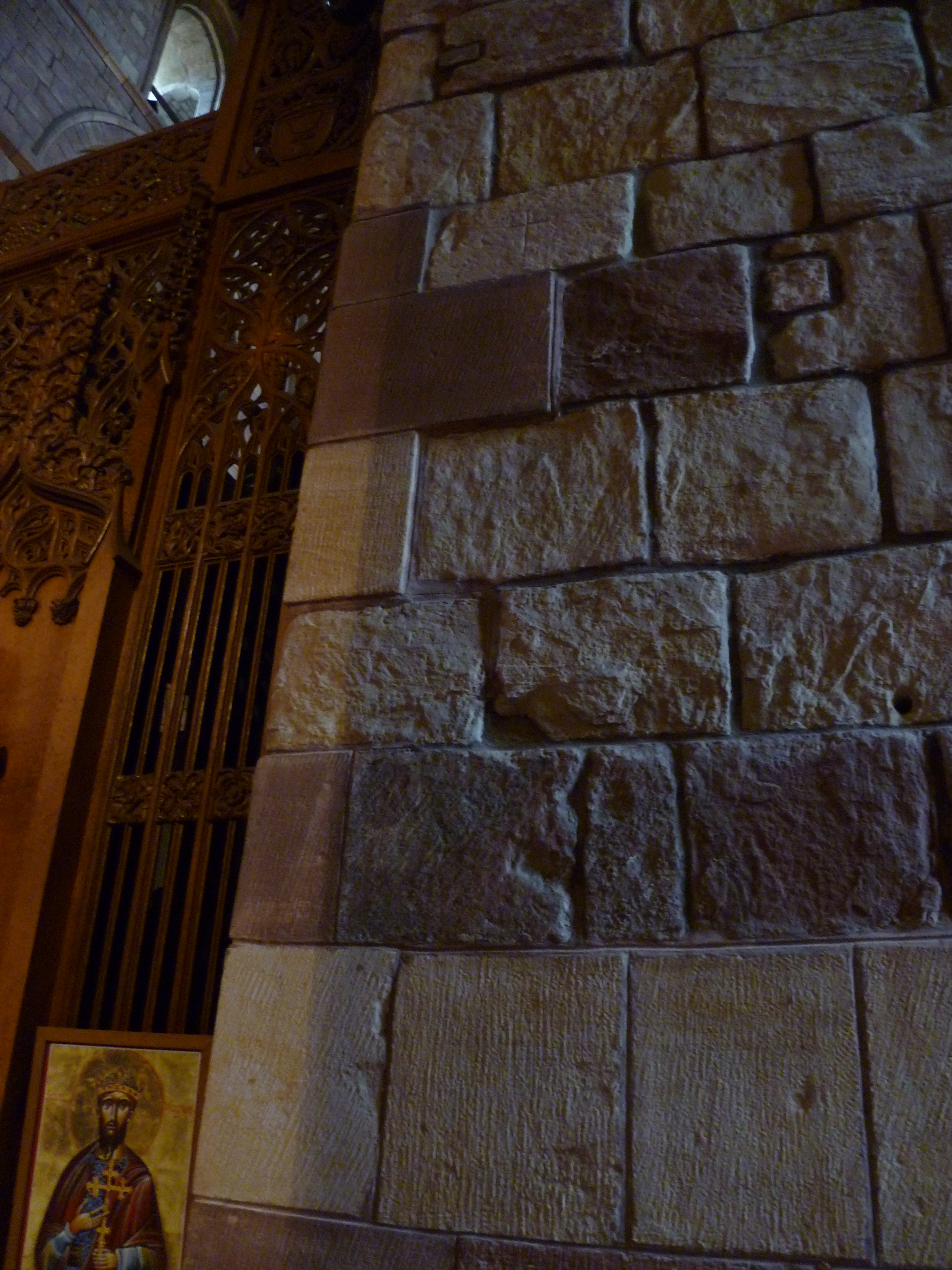
Centuries later, during restoration work in 1919, workers in the cathedral discovered a wooden box containing bones stored behind a pillar. The skull in the box showed signs of injury consistent with Magnus’s death by beheading, as recorded in the Orkneyinga Saga. The bones were replaced behind the pillar in 1925.
Other posts in this occasional series include Winchester Cathedral, Salisbury Cathedral and Truro Cathedral. Future posts will look at the cathedrals of Exeter, Ely and Southwark.
Links and Sources
- The Orkneyinga Saga, translated from the Icelandic by Jon a. Hjaltalin and Gilbert Goudie (1873), available via Project Gutenberg. Also available in Penguin Classics
- Magnus by George Mackay Brown
- Relief map of the Orkney Islands (excluding Sule Stack and Sule Skerry), UK. Contains Ordnance Survey data Contains Ordnance Survey data © Crown copyright and database right, CC BY-SA 3.0 via Wikimedia Commons
- ‘George Mackay Brown’, Poetry Foundation
- The Cost of Discipleship / Dietrich Bonhoeffer
Photo Credits
- Featured image: Doorway detail, St Magnus Cathedral, Kirkwall, Orkney. Michael Maggs, CC BY-SA 4.0, via Wikimedia Commons
- All other photos by the author. This blog is licensed under a Creative Commons Attribution-NonCommercial-NoDerivatives 4.0 International License. Photos are free to use and share, but please attribute and link back to the blog.
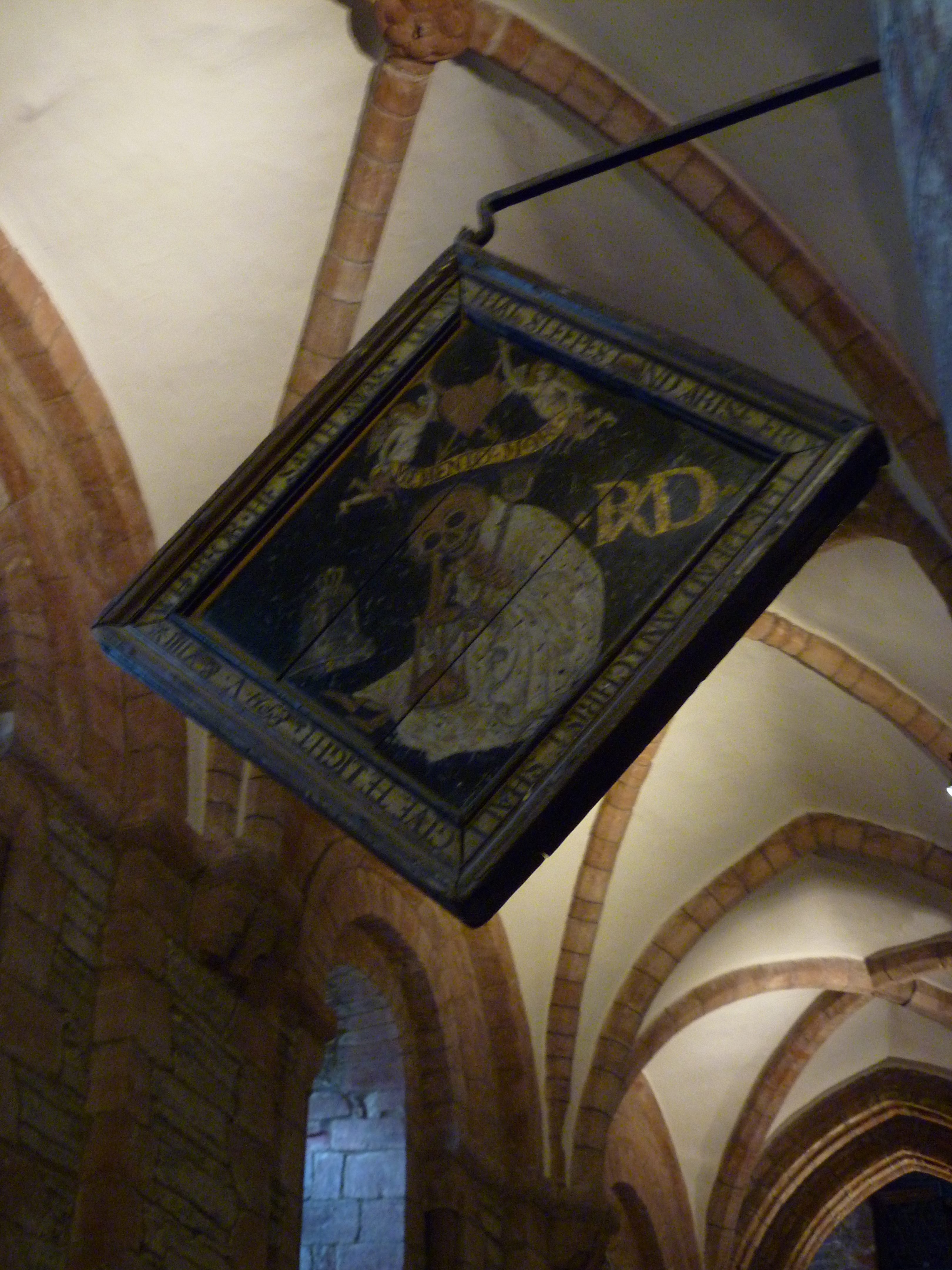
St Magnus Cathedral, Kirkwall


 Thoughts from an Idle Hour
Leave a reply to Salisbury Cathedral and Edward Rutherford’s Sarum – Thoughts from an Idle Hour Cancel reply