
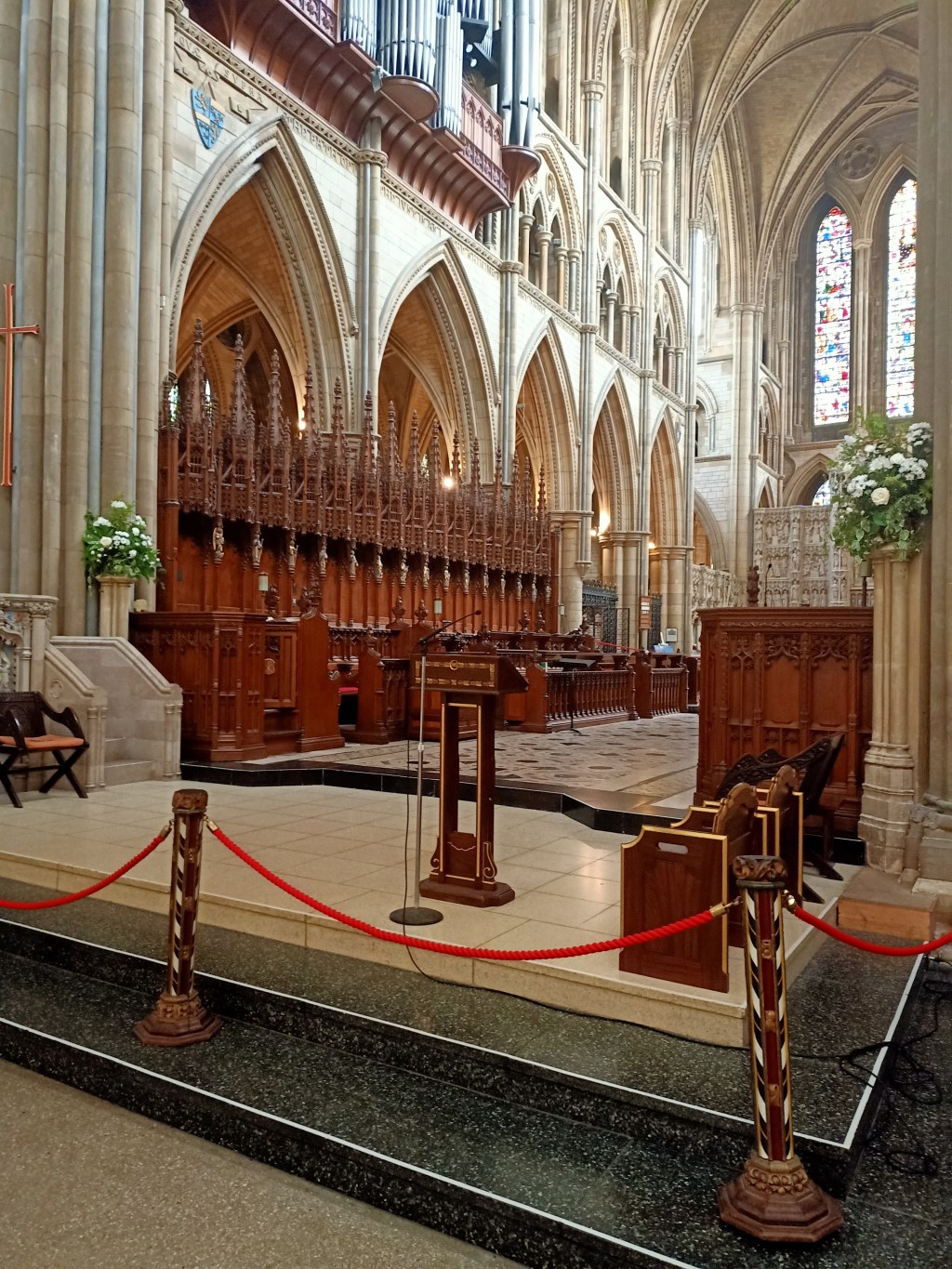
England’s cathedrals are usually centuries old; their architecture grand, their spires soaring, their furnishings elaborate. But these are not the features that remain with me after a visit to these centres of Christian worship. I tend to remember quirks and connections (especially connections to books I’ve read).
In this occasional series on UK cathedrals, I’ll share the memories that linger long after my visit. From St Mary’s, Truro, the UK’s southernmost cathedral, it is the intricate carvings of Violet Pinwill and the ‘missing’ references to the cathedral in Winston Graham’s Poldark series.
Website: Truro Cathedral
Official name: Cathedral of the Blessed Virgin Mary (Church of England Diocese of Truro)
Date: current building (replacing earlier Gothic and Georgian buildings) commenced in 1880, site dedicated for a cathedral in 1876
Location: St Mary’s St, Truro TR1 2AF
Tours: volunteer-led tours (seasonal); booked tours also available
Café: check cathedral website, not operating in early 2025
Architecture: Gothic Revival
Admission charge: no (donations welcome)
Truro Cathedral, dating from the late 19th century, is the newest of the English cathedrals I’ve visited. The Anglican Diocese of Truro was not established until 1876 so there was no need for a cathedral in Cornwall. The new diocese was created by carving off the western portion of the Diocese of Exeter.

Violet Pinwill’s Carvings
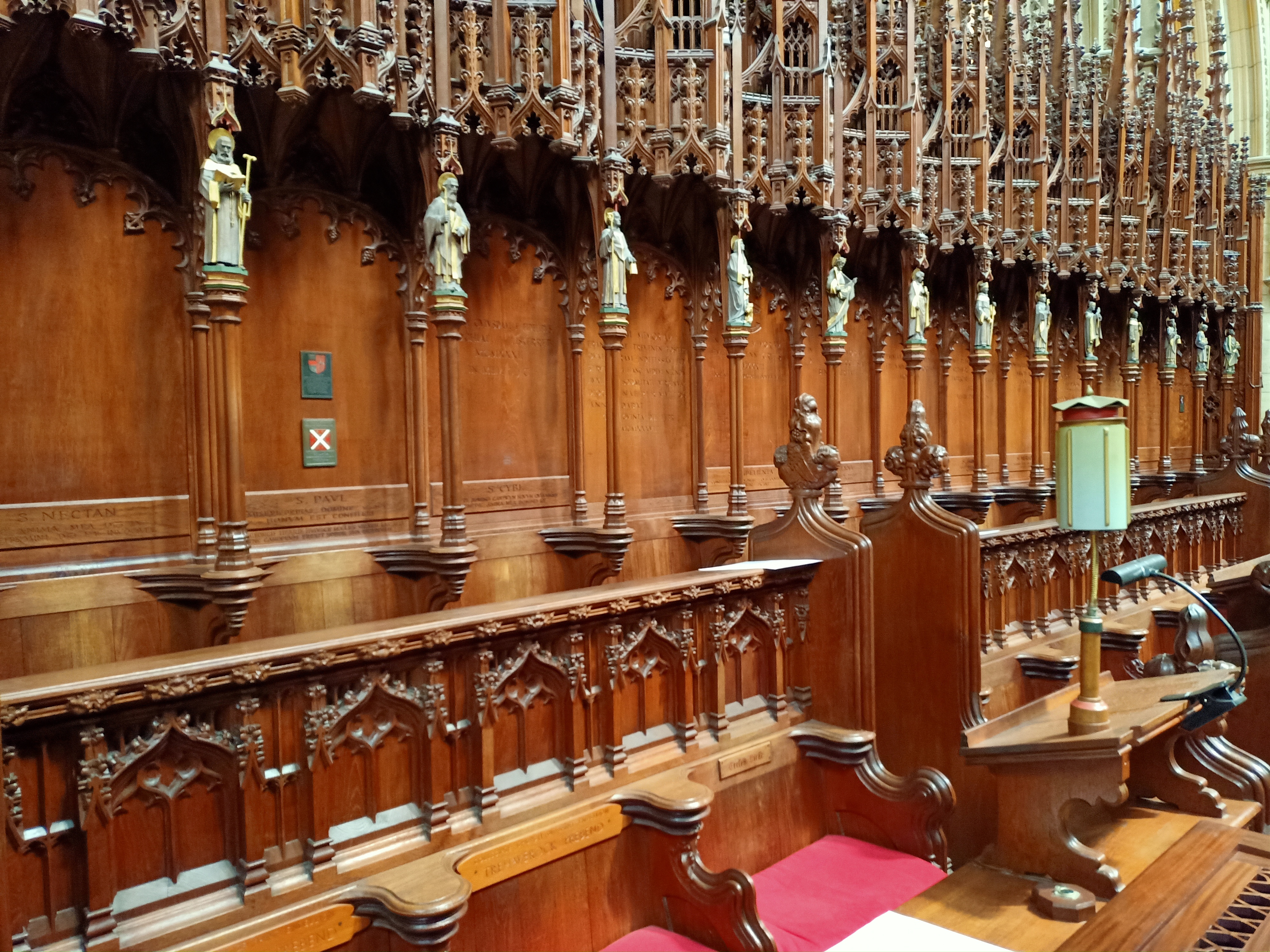
In common with many cathedrals, St Mary’s choirs stalls are backed by intricate carvings. What is unusual about the carvings in Truro Cathedral is that they were worked by an ecclesiastical woodcarving business run by a woman.
Violet Pinwill, the fifth of the Reverend Edmund Pinwill’s seven daughters, set up a company in 1890 with two of her sisters – Mary (whose middle name was Rashleigh) and Ethel. The company bore the name Rashleigh, Pinwill & Co, Ecclesiastical Carvers. Mary and Ethel left the company in the early years of the 20th century but Violet remained, working up until a few days before her death in 1957. Over 200 churches in Devon and Cornwall bear examples of her work.
Not only are the carvings in Truro’s choir stalls the work of a woman, a number of the 32 figures are women, too. Breaca, Ia, Wenn and Buriana hold equal place alongside Ruan, Petroc, Carantoc and Nectan.
Where is the cathedral in Poldark’s Truro?
In historical fiction set in a British city, some passing reference to a cathedral is not out of place. (Sometimes the cathedral is a ‘character’ in its own right. Think of Ken Follett’s The Pillars of the Earth or Edward Rutherford’s Sarum or Tracy Chevalier’s A Single Thread.)
Why then is there no mention of Truro Cathedral in any of Winston Graham’s Poldark novels, especially as the city of Truro ‘was the inspiration for the entire series of novels’? (‘A Tour of Poldark’s Cornwall’).
The answer? Because it wasn’t built.
The Poldark series is set between 1783 and 1820, decades before plans for St Mary’s Cathedral were drawn up. There was, however, already a St Mary’s church on the yet-to-be-constructed cathedral site. This substantial church ‘had witnessed the baptisms, weddings, and funerals of local families for generations’ (‘The Story of St Mary’s Aisle’).– families not unlike the Warleggans, the Trevanions and the Chynoweths.

It is this earlier building that is dotted throughout Graham’s narrative.
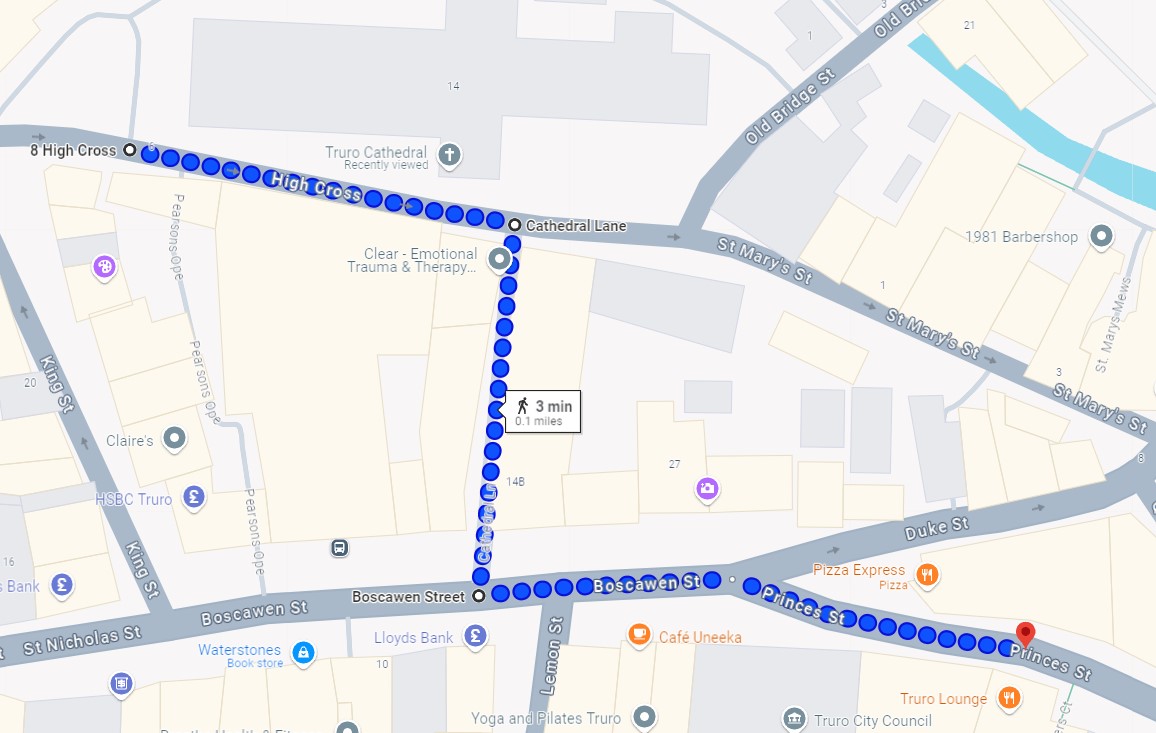
You’ll find Morwenna Chynoweth ‘ploughing through the snow to St Mary’s Church’ (The Black Moon) and Caroline Penvenen’s marriage to Dwight Enys taking place there (The Four Swans). There’s the youthful theatre party, ‘talking and laughing among themselves, making their way from High Cross to St Mary’s Church, down the slit of Church Lane [now re-named Cathedral Lane], into the new broad Boscawen Street and thence to Prince’s St’ and the Warleggan’s townhouse (The Miller’s Dance).
There’s even Captain Prideaux’s plea to George Warleggan that he initiate some action to deal with St Mary’s churchyard which had become ‘piled high with animal and human excrement’ (Bella Poldark).
Although the former St Mary’s (built in 1548) was demolished to make way for the cathedral, its south aisle was incorporated into the design and retained within the new building. Now known as ‘St Mary’s Aisle’, the remnant of the earlier building ‘still serves as a parish church – the only one within a cathedral in England’ (‘The Story of St Mary’s Aisle’).
Other posts in this occasional series include Winchester Cathedral, Salisbury Cathedral, and St Magnus Cathedral, Kirkwall. Future posts will look at the cathedrals of Exeter, Ely and Southwark.
Links and Sources
- Truro Cathedral, including information on St Mary’s Aisle
- For more about Violet Pinwill, visit biographer Helen Wilson’s website, The Remarkable Pinwill Sisters
- For more detail on the cathedral’s Pinwill carvings, see Cornish Stained Glass
- ‘The Poldark Books by Winston Graham in Order‘, Pan Macmillan
- ‘A Tour of Poldark’s Cornwall’, Pan Macmillan
- Walking route, Assembly Rooms to Cardew (Warleggan townhouse), in Miller’s Dance, image courtesy of Google Maps
Photo credits
- Truro Cathedral, Tim Green, CC BY 2.0, via Wikimedia Commons
- St Mary’s Church, Truro, pre-1850, engraved by ? Smith, from a drawing by ? Britton. For the ? of England. Public domain, via Wikimedia Commons
- All other photos by the author. This blog is licensed under a Creative Commons Attribution-NonCommercial-NoDerivatives 4.0 International License. Photos are free to use and share, but please attribute and link back to the blog.



 Thoughts from an Idle Hour
Leave a reply to Stephany Evans Steggall Cancel reply