
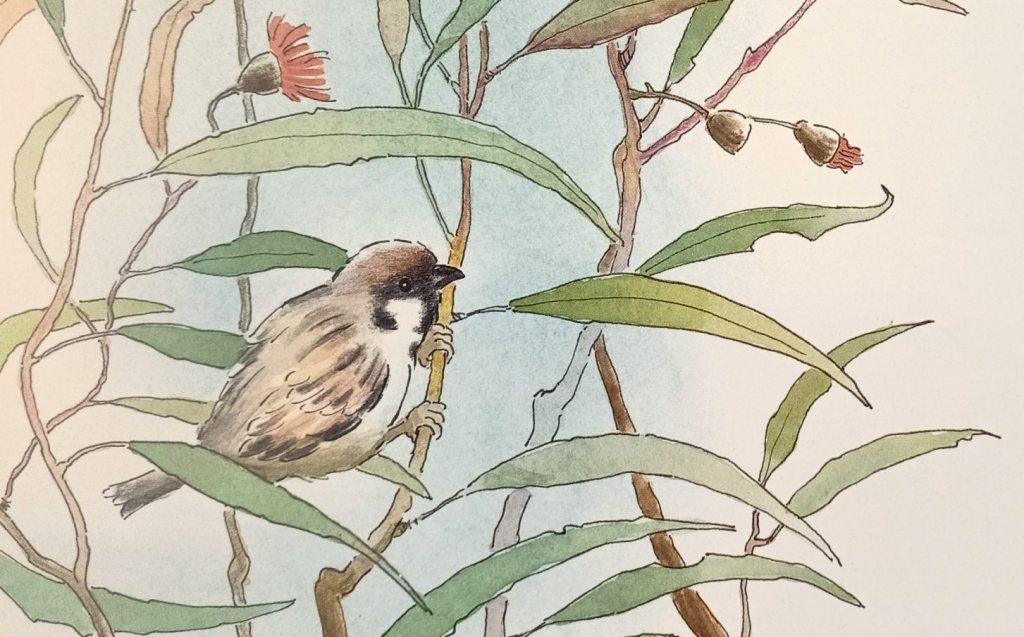
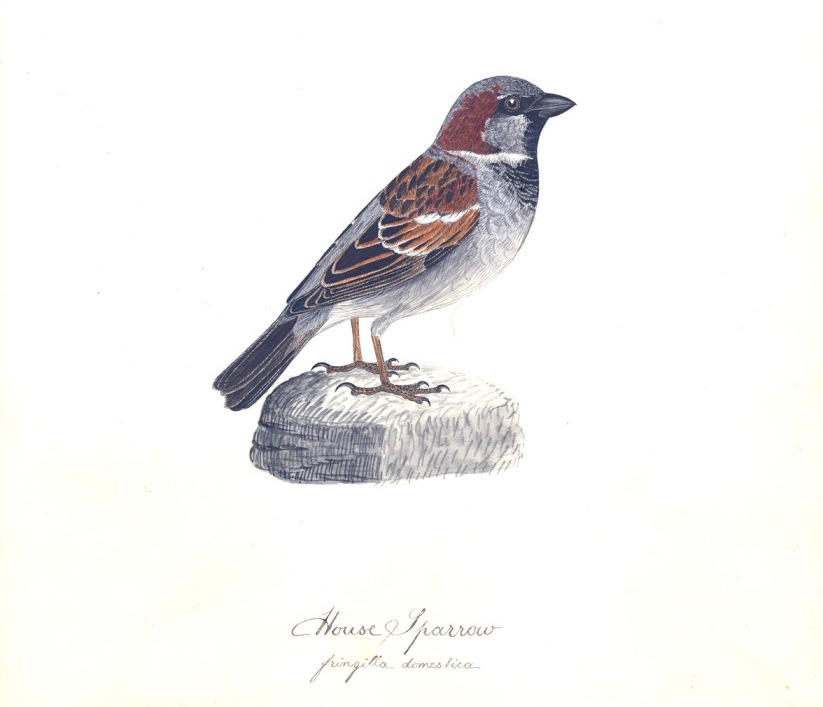
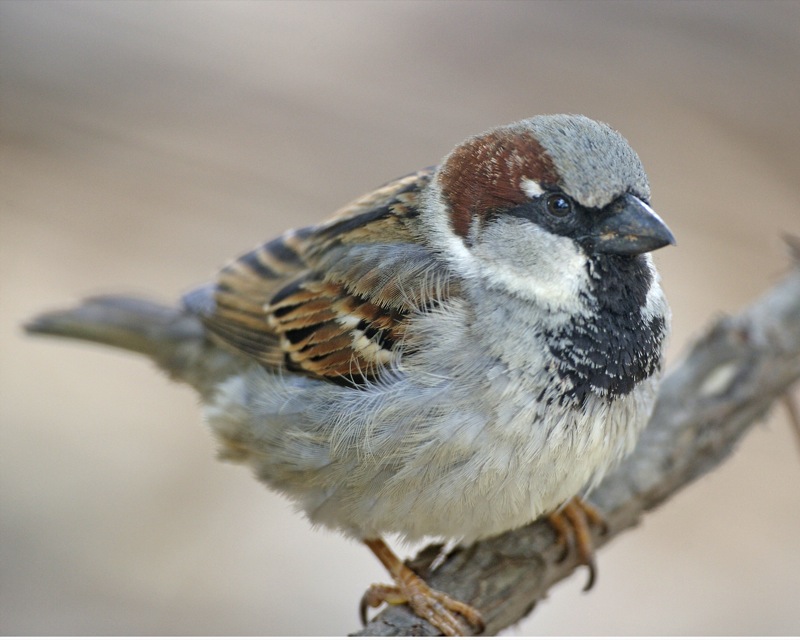
The house sparrow (Passer domesticus), a small black, grey and brown bird in the finch family, was introduced to Australia in the early 1860s. Its presence and numeric growth sparked the imaginations of poets and children’s writers alike.
Arrival
1857 – A false sighting
The sparrow’s earliest appearance (found to date) in Australian literature is in 1857. On 9 November of that year, the Illawarra Mercury published ‘Lines (on Watching Some Sparrows in the Botanical Gardens, Sydney)’ by Alfred Quaife (1937-1916).
Unfortunately, the young Mr Quaife’s bird-identification skills left something to be desired. He describes the birds he is watching as having ‘red bills’; house sparrows have black or brown bills. It’s possible that Quaife was observing a different member of the finch family – perhaps a red-browed finch or a female zebra finch. Given his previous sightings of sparrows might have been prior to his departure from England at the age of two or in book illustrations, he can be forgiven for his error.
1862 or 1863?
Most sources date the arrival of the first house sparrows to January 1863 but there is reliable evidence (‘Inaccuracies in the History of a Well-Known Introduction’) that the first cargo arrived some weeks earlier, in late November 1862. Several Melbourne newspapers reported on a trip to India undertaken by Mr G J Landells. Landells had lived variously in the West Indies, England and India before arriving in Australia in 1856. (He gained some notoriety as the importer and manager of camels for the fateful Burke and Wills expedition in 1860-1861.)
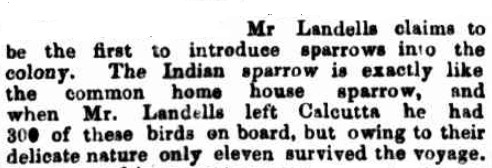
After a round-trip to India in 1862, Landells (with support from the Victorian-based Acclimatisation Society) imported orangutans, antelope, deer and chameleons along with an array of birdlife – a mockingbird and a nightingale, some turtle doves and partridges, and a collection of Indian house sparrows. Landells claimed to be ‘the first to introduce sparrows into the colony’. He had left Calcutta with 300 sparrows but ‘owing to their delicate nature only eleven survived the voyage’ (‘New Importation of Animals from India’).
The Argus newspaper (at one time edited by Edward Wilson, the founder of the Acclimatisation Society) confirmed the arrival of the birds two weeks later, acknowledging the receipt of ‘four Indian house sparrows from Mr G J Landells’ (‘Thursday, December 18, 1862’).
In January 1863, more sparrows arrived on the Princess Royal. By then, the Argus was reporting that ‘young sparrows, born of the older importations, have tumbled out of their nest, and will soon set up for themselves’ (‘Saturday, January 31, 1863’). Breeding was underway.
Impact
It had seemed like a good idea at the time…
Australia’s sparrow population grew rapidly in numbers and geographic spread. Despite being imported to foster agriculture (by attacking insects), the sparrows were soon recognised as a serious menace to fruit crops and grain stores. Within a decade, community attitudes had shifted and societies began forming for the purpose of destroying the birds (‘The Sparrow Nuisance’).
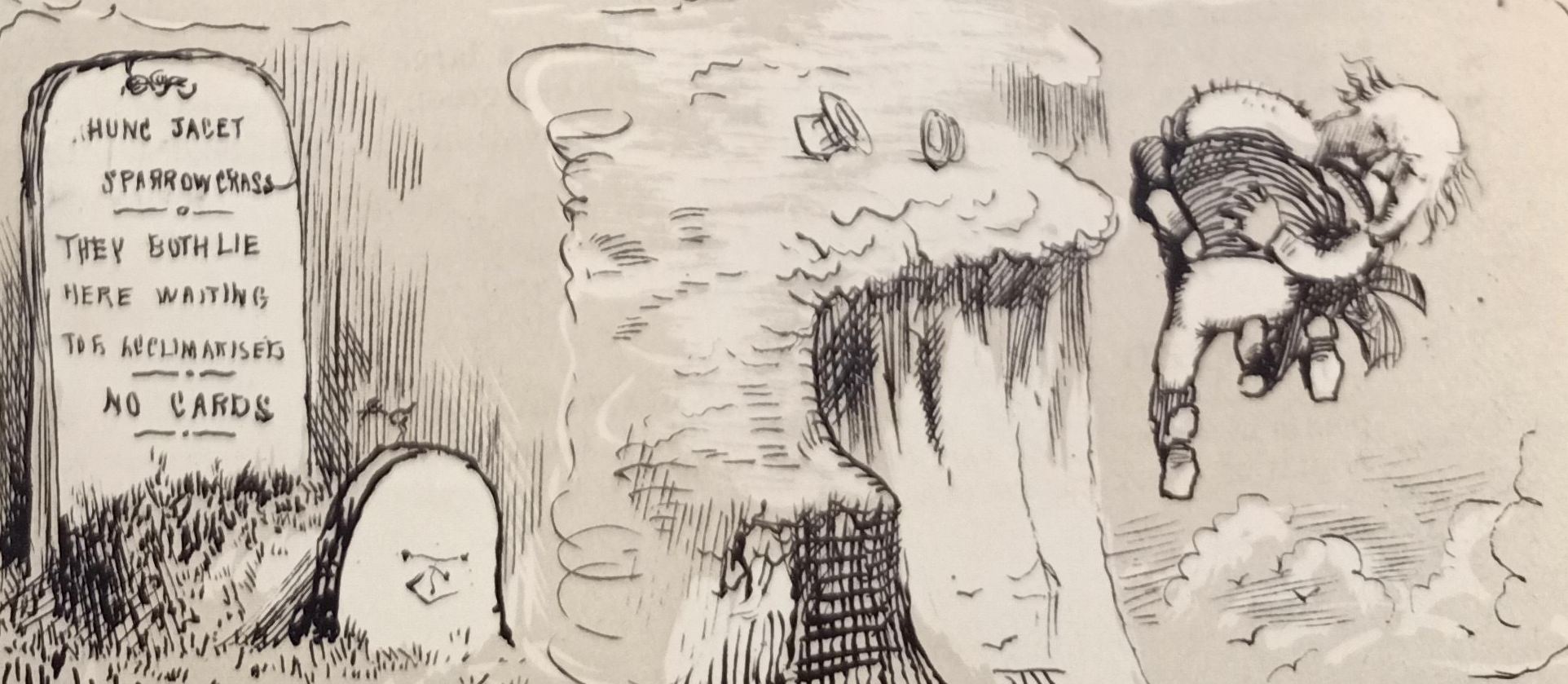
This change of heart is illustrated in a humorous tale published in Williams’s Illustrated Australian Annual in 1870. Two men, business partners and lifelong friends, find themselves on opposing sides of ‘The Great Sparrow Controversy’ and become ‘deadly enemies’. Their disagreement rages until they meet one day on the Geelong cliffs and become ‘locked in a deadly embrace of hate and malice’. Losing their balance, the former friends are dashed onto the rocks below.
Sparrows in Poetry
‘Shifty’, ‘lice-grey’, ‘tawdry intruders’
It took some time for Australia’s poets to begin penning verses on the behaviours and characteristics of sparrows and, when they did, the depictions were often unflattering.
Bellerive claimed sparrows were ‘shifty’, while John Blight seemed to have been particularly aggrieved about the presence of sparrows where seagulls ought to be. In ‘Sparrows on the Beach’ (1954) Blight imagines turning into the Pied Piper and leading all the sparrows with their ‘alley-colors’ and ‘lice-grey down’ into the sea. He would then, mercilessly, watch them drown.
In the 1960s, eminent poet Bruce Dawe was scarcely kinder. In ‘All the Spring Long’, he describes sparrows as ‘curiously unbeautiful’, ‘tawdry intruders’.
‘Bonzer little chap’
But there was one poet who viewed sparrows in a more tender light. South Australian-born William Monro Anderson travelled to England in 1893 to study dentistry and medicine. In 1917, the Adelaide Register published Anderson’s ‘The Anzac and the Sparrow: Embankment Gardens’. Not an ANZAC himself (although he had seen military service as a volunteer in the Boer War), Anderson depicts a depressed soldier in a wet and dreary London being cheered by the antics of a ‘bonzer little chap’.
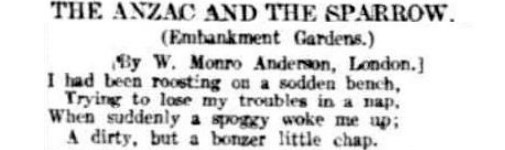
In the poem, Anderson uses the term ‘spoggy’ for sparrow – a colloquialism in common use in South Australia. A few years later, another of Anderson’s ‘spoggy’ poems (‘To a Sparrow’) appeared in the Sydney Bulletin. Once again, he casts the sparrow in a positive light: ‘It was a spoggy first that gave me pluck / to grapple with misfortune in Life’s ruck.’
Sparrows in Children’s Stories – Heroic Adventurers
Long before the poets turned their creative attention to sparrows, writers for children were on the job. It took less than a decade after the arrival of the first sparrows in Melbourne for the little birds to appear in a locally-written children’s story.
Marcus Clarke, best known for the convict novel His Natural Life, published ‘The Acclimatised Sparrow: A Story for Children’ in 1870. Clarke begins his tale of a sparrow family’s migration from London to Melbourne and then to Ballarat’s goldfields. One member of the newly arrived sparrow family finds his way to the home of an old woman. Lonely and dying, the woman’s final hours are cheered by sparrow song and memories of her former life in London.
Sparrows also feature in a benevolent light in Atha Westbury’s fairy story Three Sparrows (another Ballarat goldfields tale, published in1897); in Dulcie Bellhouse’s 1945 picture book Betty’s New Hair Ribbon (in which a sparrow returns Betty’s lost ribbon); and in Judith Crabtree’s fable The Sparrow’s Story: At the King’s Command (1983), dedicated to ‘those who have tried and think they have failed’.
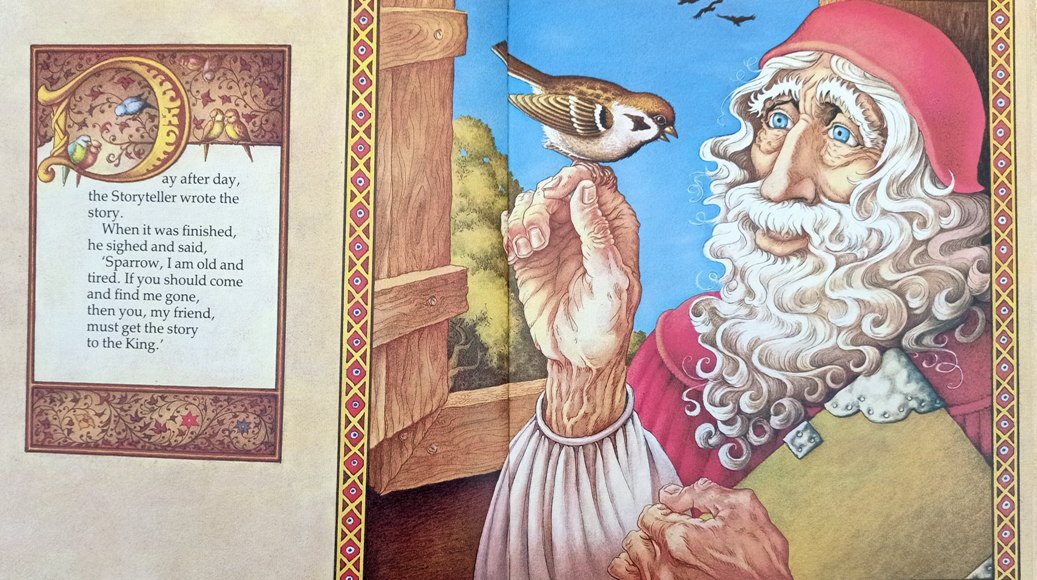
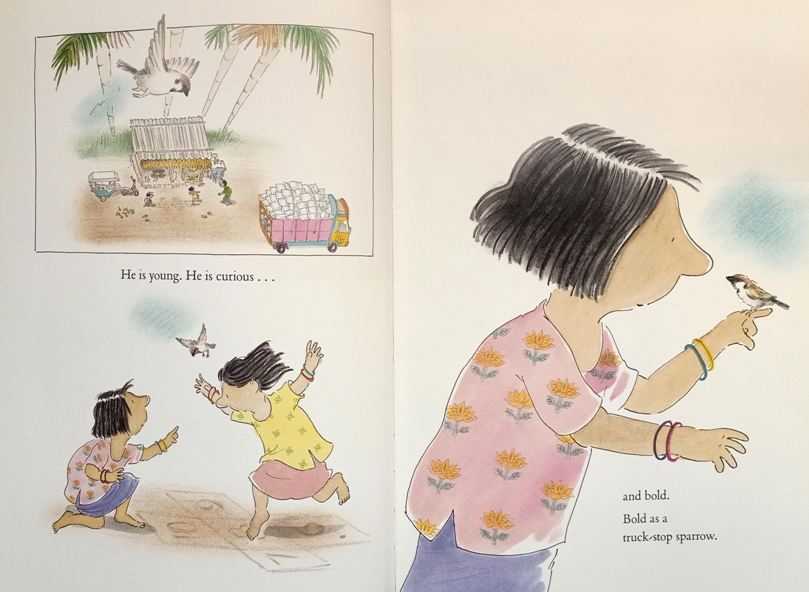
In 2014, Bob Graham brings Australia’s sparrow-migration story full circle.
In Vanilla Ice Cream, a new sparrow arrives on Australia’s shores from India. In Graham’s picture book, this curious and bold truck-stop sparrow hops aboard a ship-bound cargo and eventually arrives at the Café Botanica in Sydney … perhaps near the very spot in the Botanic Gardens where Mr Quaife thought he saw a sparrow way back in 1857.
Links and Sources
- Featured image: Detail from endpapers, Vanilla Ice Cream, Bob Graham, Newtown: Walker Books, 2014
- ‘Lines (On Watching Some Sparrows in the Botanical Gardens, Sydney’, Illawarra Mercury, 9 November 1857, p.1
- ‘Inaccuracies in the History of a Well-Known Introduction: A Case Study of the Australian House Sparrow (Passer domesticus)’ by Samuel Andrew and Simon Griffith. For a summarised version of Andew and Griffith’s findings, see ‘City Sparrows Came to Australia via India‘
- For more on G J Landells role in the Burke and Wills expedition, see William John Wills’ Successful Exploration through the Interior of Australia, from Melbourne to the Gulf of Carpentaria
- ‘New Importation of Animals from India’, The Age, 3 December 1862, p.5
- ‘The Sparrow Nuisance’, South Bourke Standard, 8 December 1871, p.7
- ‘The Acclimatised Sparrow’, The Australasian, 29 January 1870, p.5
- ‘A Rhyme of Sparrows’, Bellerive, The Bulletin, 4 December 1946, p.5
- ‘Sparrows on the Beach’, John Blight, The Bulletin, 28 April 1954, p.13
- ‘All the Spring Long’, Bruce Dawe, No Fixed Address, Melbourne, Vic.: Cheshire, 1962, p.54
- ‘The ANZAC and the Sparrow: Embankment Gardens’, William Monro Anderson, The Register, 12 May 1917, p.4
- ‘To a Sparrow’, William Monro Anderson, The Bulletin, 30 September 1920, p.24
- ‘The Acclimatised Sparrow: A Story for Children’, Marcus Clarke, The Australasian, 29 January, 1870, pp.133-134
- ‘Three Sparrows’, Atha Westbury, Portland Guardian, 18 November 1895, p.1 (and other newspapers) and in Australian Fairy Tales, London: LockWard, 1897, p. 82-90
- Betty’s New Hair Ribbon, Dulcie Bellhouse (author) and Kay Druce (illustrator), Sydney: Offset Printing, 1945
- The Sparrow’s Story: At the King’s Command, Judith Crabtree, Melbourne: Oxford University Press, 1983
- Vanilla Ice Cream, Bob Graham, Newtown: Walker Books Australia, 2014
More sparrows…
- For a detailed map of sparrow distribution in Australia, see ‘House Sparrows’, Atlas of Living Australia
- For more about sparrow colloquialisms (including ‘spadger’, ‘spoggy’ and ‘spriggy’), see The Australian National Dictionary
- All newspaper items, stories and poems cited in this post were found through searches on AustLit and Trove. AustLit (St Lucia: The University of Queensland, 2002– ) lists over 150 works of Australian literature with the subject ‘sparrows’; a search of Trove (Canberra: National Library of Australia, 2009– ) yields almost 500,000 items that include the word ‘sparrow’, ranging from books and newspaper articles to music and pictures.
My thanks to the staff and volunteers of these rich reference sources for their ongoing work.


 Thoughts from an Idle Hour
Leave a comment