
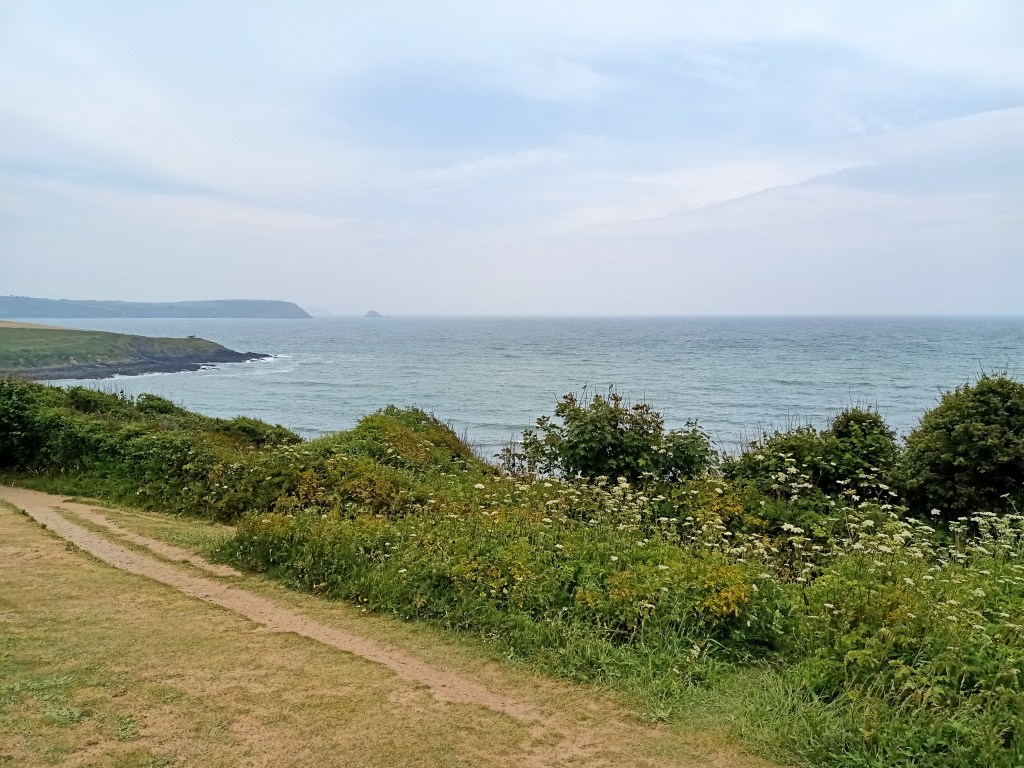
In the summers of 2013 and 2014, Raynor Winn and her husband Moth walked the UK’s South West Coast Path.
It was not a journey undertaken after extensive planning; it was not the realisation of a lifelong dream. It was a decision made in extremis after two life-altering judgements.
In a court of law, the Winns were deemed liable for another man’s debts; in a doctor’s hospital room, Moth was diagnosed with corticobasal degeneration (CBD). The judgements left Raynor and Moth homeless and shocked.
‘We lost. Lost the case, lost the house, and lost ourselves.’
Faced with an uncertain future, and an income of just £48 per week, the couple opted to buy time by wild camping along the 630 mile (1,014km) coastal path through Devon, Cornwall and Dorset.
With limited resources, Raynor and Moth purchased modestly priced rucksacks, a 3kg tent and super lightweight sleeping bags. They packed basic provisions, including an exercise book and a pen. Two books accompanied them: Seamus Heaney’s translation of Beowulf and Paddy Dillon’s The South West Coast Path: From Minehead to South Haven Point. Fully packed, the two rucksacks weighed 8kgs apiece.
Raynor Winn’s account of their walk, titled The Salt Path, was published in 2018. (Seven years later, Number 9 Films released a movie based on their journey starring Gillian Anderson and John Isaacs.)

‘It was just a coastal path after all; it couldn’t be that hard and we would walk slowly, put one foot in front of the other and just follow the map. I desperately needed a map, something to show me the way. So why not? It couldn’t be that difficult.’
Reading Raynor’s story prompted questions about home, about change and identity, about living in nature, about planning and risk-taking. Here are some of those questions. They may be of use to book clubs; if so, feel free to share them.
(Note: see the Postscript at the end of this post re claims concerning the veracity of Raynor’s account.)
Home and homelessness
‘We’re homeless. We lost our home and we’ve nowhere to go.’
Raynor talks about ‘home’ in diverse ways. It’s the land on which she farmed, the structure in which she lived (a house or a tent), the coast path she trod. It is sanctuary, belonging, ownership, memory holder. It is a man named Moth.
- What does ‘home’ mean to you? How do you create it?
‘At last I understood what homelessness had done for me. It had taken every material thing that I had and left me stripped bare, a blank page at the end of a partly written book. It had also given me a choice, either to leave that page blank or to keep writing the story with hope. I chose hope.’
Planning and Preparation
‘The great thing about not preparing for a journey, not reading about every place before you visit, is that things can still take you by surprise.’
Raynor and Moth’s walk did not entail months of planning and preparation. No mapping out of the distances to be travelled each day, no designated overnight stopping points, no reconnoitring of ATM or fresh water locations. No physical training to ready the body for the challenges ahead.
- Are there risks inherent in not planning? Does not having a plan bring freedom or constraint or both?
- What aspects of the walk took Raynor and Moth by surprise (pleasantly or otherwise)?
‘”Do we have a plan?”
‘”Course we do. We walk, until we stop walking, and maybe on the way we find some kind of future.”’
Identity
‘Most people go through their whole lives without answering their own questions: What am I, what do I have within me? The big stuff. What a waste.’
Prior to the walk, Raynor’s identity was bound up in being a small businesswoman, a farmer, a mother, a wife. As a homeless woman on the coast path, unable to provide a ‘protecting hand’ for her young adult offspring, and facing the prospect of life after Moth’s death, she faces profound questions about her identity.
An experience early in the walk crystalises her loss of identity. While she is counting the coins in her hand, Raynor is knocked off balance by a dog and the coins spill to the ground. Scrabbling to collect them, the dog owner berates her: ‘You tramps should learn how to control yourselves. Rollling around in the street – it’s disgusting.’ Years later, Raynor told the Guardian newspaper, ‘I think that was the point where my sense of self fell apart, the sense of who I was.’ (‘Nature Was My Safe Place’)
- What relationships provide the scaffold for your identity?
- Can a relationship with place frame identity as firmly as a relationship with people?
- If you were introducing the post-walk Raynor to a friend, how would you identify her? If you were being introduced to Raynor, how might a friend identify you?
On the final night of the walk, with the next phase of life in sight, Raynor wonders about her future: ‘What would I be, who would I be? I didn’t know, but it was all right not to; the past was on another headland and I was happy to leave it there. I could at last look to the future with hope.’
Change
‘Our journey had drained us of every emotion, sapped our strength and our will. But then, like windblown trees along our route, we had been re-formed by the elements into a new shape.’
Over the passage of the walk, Raynor recognises the changes taking place within her. ‘I was no longer striving, fighting to change the unchangeable … a new season had crept into me, softer season of acceptance.’
The legal judgement and Moth’s CBD diagnosis ruptured Raynor and Moth’s previous existence; the walk itself could have compounded their dislocation. Instead, they reach a place of acceptance and are reformed.
- What attitude of mind and spirit is required to make the changes that Raynor and Moth made?
- Over the course of the walk, Raynor and Moth discover a ‘refound muscularity’. Does their physical condition contribute to their mental and psychological change? If so, in what way?
‘Our path was becoming smoother, less jagged, less tossed by the storms, more a flow of slow-running water of tide-rippled sand. We had changed with the path, become stronger, calmer, our passage quieter.’
Connecting with nature
‘The path passed through a ravine cut by a small stream, the banks filled with flowers, as if all the gardens of Zennor had shed their seeds into the water, to be caught up by the damp soil and bloom in profusion in a wild, hidden garden.’
Raynor becomes increasingly observant of the natural world as she walks. Initially, clouds are described as ‘scudding’ and ‘strange’ and ‘dark’. Later in her book, she writes of ‘a soft yellow light giving the broken clouds a luminescent glow’; she can identify ‘streaks of white stratocumulus clouds’ and a wind that roars through ‘the grey broil of cloud, hurling the cumuli east’. As she changes, her language changes, too.
- Would Raynor have changed in the same ways if her walk had been through a different landscape? What if the guidebook she had kept from decades earlier had not been for the South West Cost Path but instead was for the Thames Path or the Hadrian’s Wall Path or the Pennine Way? Would an inland route have affected her differently?
At Portheras Cove, a passerby who learns of Raynor and Moth’s wild camping along the coast, remarks: ‘It’s touched you, it’s written all over you: you’ve felt the hand of nature. It won’t ever leave you now; you’re salted.’
Grief
‘Die – just do it and die now. Don’t drag me through death with you. If you’re leaving, just go, don’t condemn me to years of letting go, sitting by, waiting for the iced blade to cut my heart out, rip me bone from bone, leave me macerated, spewed out, screwed up. If you’re going, just go, get it over with. I can’t say goodbye, can’t live without you. Don’t leave. Ever.’
The unavoidable backdrop to the walk – and to the future – is Moth’s CBD diagnosis. Raynor is torn between her inability to say ‘goodbye’ and her wish for Moth to ‘get it over with’.
[As of mid-2025, Moth and Raynor are living in Cornwall.]
- How does having someone die suddenly and without warning differ from an anticipated death where dying takes place over a prolonged period?
- What attributes do Moth and Raynor embody that enable them to live fully in the liminal space between living and dying?
‘Life is now, this minute, it’s all we have. It’s all we need.’
Postscript (added in August 2025)
Writing for the UK newspaper The Observer in July 2025, reporter Chloe Hadjimatheou documented claims that significant aspects of Raynor Winn’s story were untrue. After extensive research, Hadjimatheou concludes:
‘The power of a true story lies in the fact that it’s true: it promises to tell the reader something real about what it is to be human and what’s possible.’
‘Raynor Winn’s publisher says her story is “unflinchingly honest”. It’s not. The story, no doubt, has elements of truth, but it also misrepresents who [Winn and her husband] were, how they started out on their journey and the financial circumstances that provided the backdrop.’ (‘The Real Salt Path: How a Blockbuster Book and Film Were Spun from Lies, Deceit and Desperation’)
- Does Hadjimatheou’s report affect your reading of the book? Does your response to the Winn’s journey change in the light of the reporter’s revelations?
Links and sources
- All quotations from The Salt Path by Raynor Winn, Penguin, 2018
- Raynor Winn continues to walk and write. Since completing The Salt Path, Winn has published two more books: The Wild Silence (2020) and Landlines (2022)
- The South West Coast Path: From Minehead to South Haven Point by Paddy Dillon, Cicerone Press, 2003
- South West Coast Path, National Trails (UK)
- The Salt Path (movie), Number 9 Films, 2025
- ‘”Nature Was My Safe Place”: Raynor Winn on Homelessness and Setting off on a 630-mile Walk’, by Sam Wallaston, The Guardian, 6 December 2018
- ‘The Real Salt Path: How a Blockbuster Book and Film Were Spun from Lies, Deceit and Desperation’, by Chloe Hadjimatheou, The Observer, 6 July 2025
- Raynor Winn (website), includes a statement in response to Hadjimatheou’s article
Photo credits
- All photos by the author. This blog is licensed under a Creative Commons Attribution-NonCommercial-NoDerivatives 4.0 International License. Photos are free to use and share, but please attribute and link back to the blog.
- Featured image: The South West Coast Path between Portscatho and Porthcurnick Beach, Cornwall
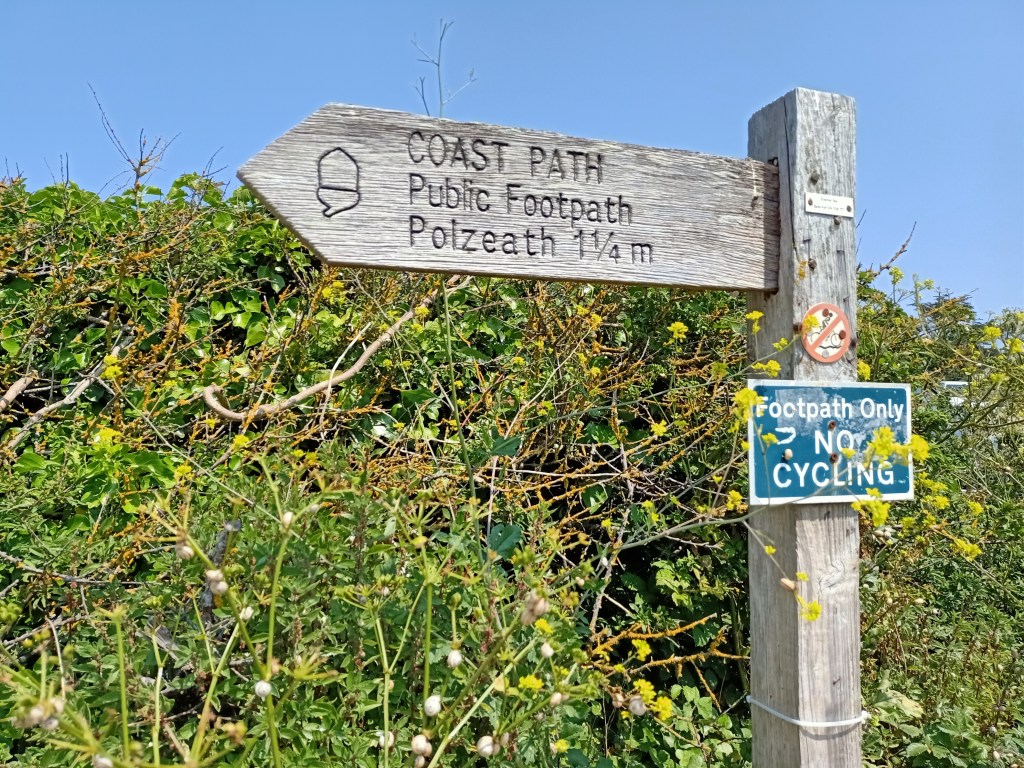
‘Very soon all the pages of The South West Coast Path: Minehead to South Haven Point would be held tight by a frayed black elastic band; there would be nowhere left to go but into the future, whatever that was.’
South West Coast Path signage, Daymer Bay, Cornwall

 Thoughts from an Idle Hour
Leave a comment