
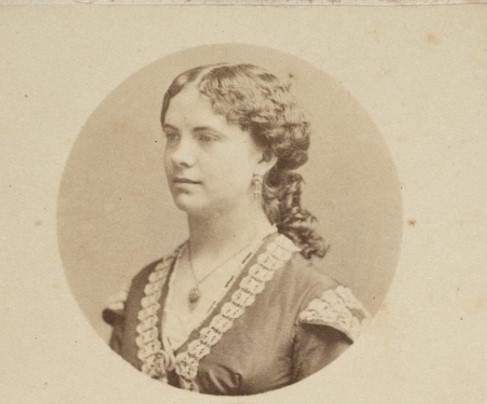
Who killed Alice Maes (aka Marie St Denis)? Could it have been, as novelist Jane Sullivan imagines, an eminent Melbournian or did she die, as her death certificates states, by her own hand?
Murder in Punch Lane – the novel
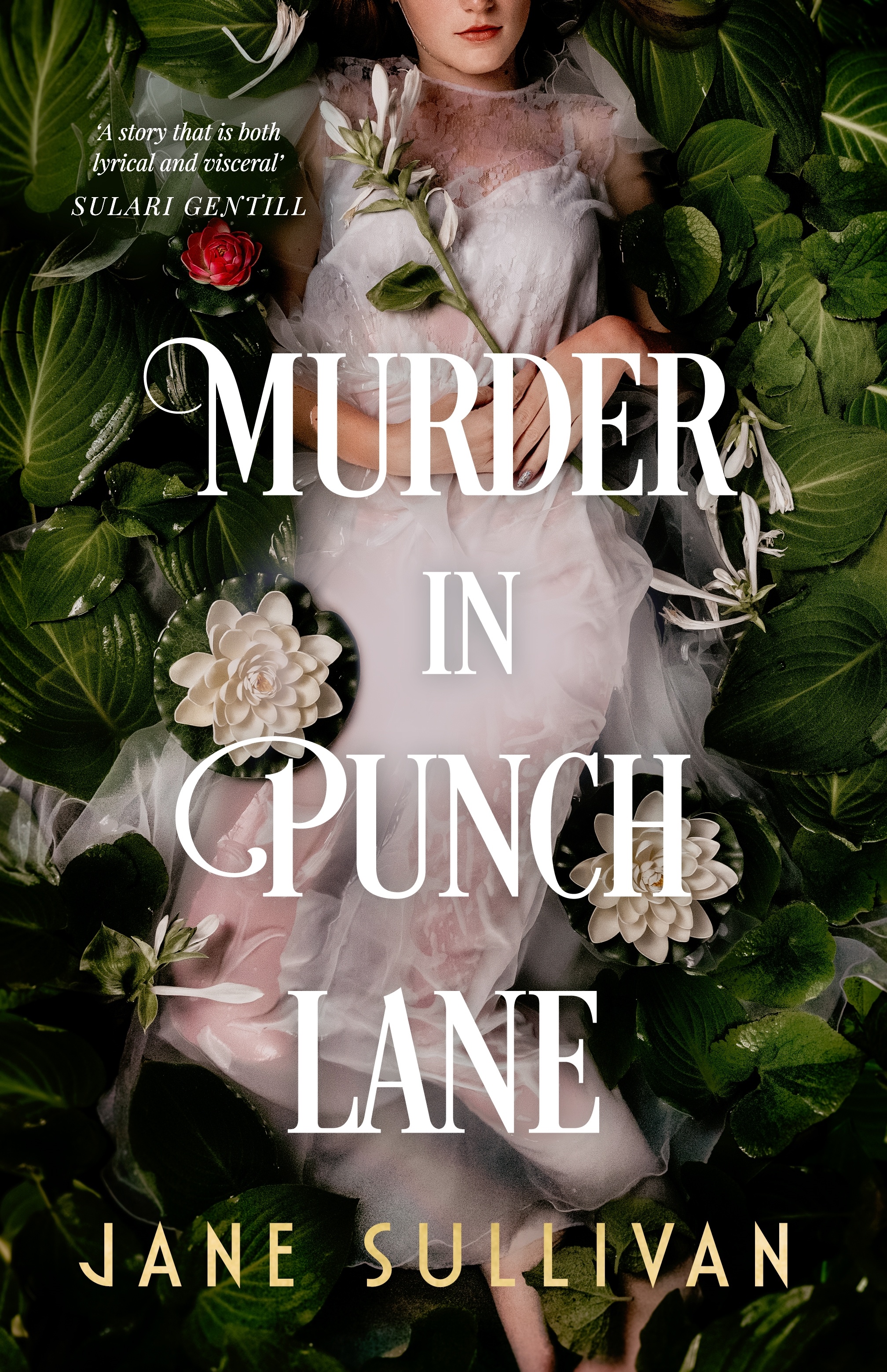
In Murder in Punch Lane, Jane Sullivan creates a murder mystery plot surrounding the death in 1868 of rising theatre star Marie St Denis.
In Sullivan’s tale, fictional actress and amateur sleuth Lola Sanchez and her sidekick , journalist and magazine editor Magnus Scott, investigate possible suspects in St Denis’s death.
Who could have had a motive for killing the 20-year-old actress? Sullivan suggests St Denis was privy to the secrets of Melbourne’s theatre world and was no stranger to ‘gentleman callers’. Could someone have shared a secret so grave they would kill to protect it?
Sullivan’s suspects include American-born Shakespearian actor Walter Montgomery, judge and philanthropist Sir Redmond Barry, police commissioner Sir Frederick Standish, and forensic pathologist and drama critic Dr James Edward Neild. (Each man sufficiently prominent in the gold rush flushed colony to eventually warrant an entry in the Australian Dictionary of Biography.)
Sullivan sends Sanchez and Scott into Melbourne’s wealthiest parlours and grimiest opium dens in search of clues. As is often the case in murder mysteries, the answer is hiding in plain sight. The ‘real life’ question of why a budding actress died in her bedroom is less easily explained.
Who Was Alice Maes (aka Marie St Denis)?

Born in Mechelen, Belgium in 1848, Alice Hyacinthe Jacqueline Marie Maes was the daughter of a Flemish father and an English mother. Her father, Edouard Maes, died when Alice was 10-years-old, after which her mother, Georgina, moved the family to London.

The widowed Georgina lived in Paddington for several years before migrating to Melbourne with two of her children – Alice, by then aged 14, and her older sister Marie, aged 31.
Georgina’s plan to earn a living through teaching was thrown into disarray when Marie contracted typhoid and died within a few weeks of their arrival in Melbourne. With only the young Alice to assist her, Georgina traveled to the town of Clunes and opened a school. The venture was not a success.
Alice took up work as a governess, first in Clunes and then in Geelong. She had been educated in a French convent and her grasp of languages and literature drew attention, not least from theatre manager and actor William Hoskins. Under Hoskins’ tutelage, Alice made her stage debut at Melbourne’s Theatre Royal in November 1866 in the lead role of ‘Constance’ in Sheridan Knowles’ The Love Chase.

Morphing into Marie
Adopting the stage name ‘Marie St Denis’, Alice’s debut performance drew mixed reviews in the colonial newspapers but the theatre critics were generally encouraging. The Melbourne correspondent for The Ballarat Star declared that, after overcoming her opening night nerves, Marie St Denis’s next performance was ‘bright, sparkling, vivacious and wilful … Taking into consideration that [Constance] is the first personification she has ever attempted in public, her success must, in fairness, be set down as brilliant’ (23 November 1866).
In the months ahead, the promising actress played Ophelia (in Hamlet) and Juliet (in Romeo and Juliet), and these successful roles were followed by a season in Adelaide as leading lady in George Coppin’s theatre company.
But less than two years after making her stage debut, and with her theatrical star seemingly rising, Alice/Marie was dead.
‘Poisoning by laudanum’
Having returned to Melbourne from Adelaide, Marie eventually found accommodation in a boarding house run by a Mrs Bellman. On the evening of 23 October 1868, Mrs Bellman found the young actress insensible on her bed and called for Dr James Edward Neild. It was not the first time Dr Neild had attended Marie following an overdose but, despite pumping her stomach four times, he was unable to revive her on this occasion. She died the following morning.
When Mrs Bellman had discovered Marie, she noticed her young guest clutching some letters, one of which was addressed to the landlady herself. It read, in part: ‘I have taken laudanum; but cannot make up my mind to have my body cut to pieces at the inquest, so I have written to Dr. Neild asking him to give an undertaker’s certificate saying death arose from anything he likes to mention … I fervently hope Dr. Neild will grant my request. You urge him to it also, please, for I should not like it to become public that I have committed suicide.’ (‘Suicide of Mdlle St Denis’, The Argus, 26 October 1868, p.6)
Her wishes fell on deaf ears. Dr Neild put the cause of death plainly, ‘poisoning by laudanum’, and an inquest was held the same day, 24 October 1868.

Why suicide?
Marie’s letter to Mrs Bellman included the declaration: ‘Don’t think me mad. I cannot live without him.’ This was a reference to a married man she had met in Adelaide and who had provided financial support to Marie. Newspaper reports claimed that when the man in question later arrived in Melbourne (with his family) he spurned contact with his former paramour.
Was this what lay behind Marie’s suicide? Perhaps. But is it also possible that her identity had morphed so completely from Alice Maes into Marie St Denis that she identified only as her acting personas?; characters – like Ophelia and Juliet – who all too often came to grief? (In her final role in Melbourne, she had taken the lead in Lady Audley’s Secret. In the play, Lady Audley swallows poison when her bigamous entanglements are discovered.)
Over 20 years after Marie St Denis’s death, the Melbourne magazine Table Talk published an article written by Dr Neild in which he speaks glowingly of Marie’s attributes – her ‘well-cultivated mind’, her facility with languages, her knowledge of literature and her accomplishments as a musician. He firmly believed she did not die ‘for love’ but had wanted her death to appear that way:
‘She was never more an actress than in the episode of her death … She had put on a most elegantly embroidered nightgown. She had jewels and flowers in her hair, chains round her neck, gemmed crosses on her bosom, and rings on her fingers. There were flowers on her pillow and on the coverlid of her bed … She had hoped to be found dead arrayed in all her elegant bravery.’
Neild’s assessment was that Marie St Denis’s disappointed hopes were not of a romantic kind but of a professional nature. Her sporadic attempts to publish her writing had been rejected and her aspirations in the world of opera thwarted. She could not envision a future for herself.
Burial
Alice Hyacinthe Jacqueline Marie Maes was buried at Melbourne General Cemetery on 26 October 1868. For reasons now unknown, she was moved to a different section of the Church of England compartment on 29 October. (Her mother had initially objected to her daughter’s burial in the Anglican section and would have preferred the Catholic compartment but this did not occur.)
Eventually, a gravestone at the second site would bear an inscription naming Alice’s mother Georgina (d. 16 January 1871), her sister Marie (d. 19 March 1863) and two of Jean Baptiste Maes’s (Alice’s brother’s) children – eight-year-old Laura (d. 18 June 1890) and the infant Edgar (d. 9 January 1887).

Alice/Marie in Storyland
Jane Sullivan’s novel, Murder in Punch Lane, brings 1860s Melbourne to life – the emerging upper class peopled by the likes of Sir Redmond Barry and Sir Frederick Standish, the theatre scene with its swelling ranks of visiting English and American actors, and the growing city’s less savoury underbelly concealed in bordellos, riverside shanties and opium dens.
The fictional premise that Marie St Denis was murdered offers a colourful excursion into this world. But perhaps there’s another book waiting in the wings, one in which Alice Maes does not take the role of a corpse but that of an independent, possibly naive, young woman seeking a foothold in a wider world.
Links and Sources
- Murder in Punch Lane / Jane Sullivan, published by Allen & Unwin, July 2024
- Jane Sullivan’s website
- Jane Sullivan discusses Murder in Punch Lane on the ABC radio program Nightlife, ‘A Murder Mystery in Victorian Era Melbourne’s Theatre Scene’
- Marie St Denis, Famed Australian (signed carte de visite)
- Australian Dictionary of Biography entries: Walter Montgomery, Sir Redmond Barry, Sir Frederick Standish, Dr James Edward Neild
- Advertisement for The Love Chase, The Herald, 19 November 1866, p.2
- Review of Marie St Denis’ performance in The Love Chase, The Ballarat Star, 23 November 1866, p.2
- ‘Suicide of Mdlle St Denis’, The Argus, 26 October 1868, p.6 (The newspaper report ran to some 4,000 words and was reproduced in full in numerous colonial newspapers.)
- ‘Marie St. Denis’ by J.E.N. [James Edward Neild], . (1889, December 26). Table Talk, 26 December 1889, p. 13
- Maes family grave, Melbourne General Cemetery, Find a Grave, Memorial ID 188635743, maintained by Tony M. (contributor 48299134).
- ‘The Love Drama of Marie St Denis’ / The Man in the Mask, Smith’s Weekly, 29 April 1933, p.21
Further reading
- Sensational Melbourne: Reading, Sensation Fiction and Lady Audley’s Secret in the Victorian Metropolis / Susan K. Martin & Kylie Mirmohamadi. North Melbourne, Vic. : Australian Scholarly Publishing, 2011
- Double time: Women in Victoria, 150 Years / edited by Marilyn Lake and Farley Kelly. Ringwood, Vic. : Penguin Book, 1985
- ‘Marie St Denis’ / Mimi Colligan, in Explorations: A Bulletin Devoted to the Study of Franco-Australian Links, no. 1, May 1985, p.15
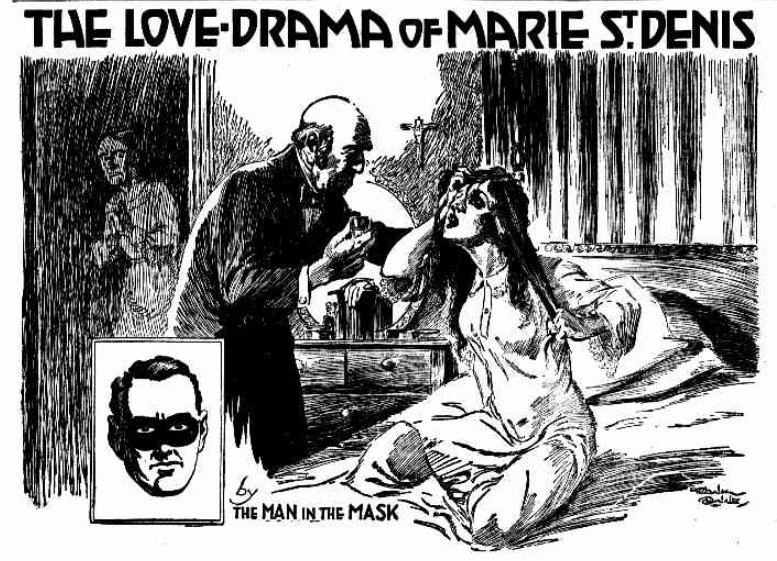
‘The Love Drama of Marie St Denis’ / The Man in the Mask, Smith’s Weekly, 29 April 1933, p.21



 Thoughts from an Idle Hour
Leave a comment