
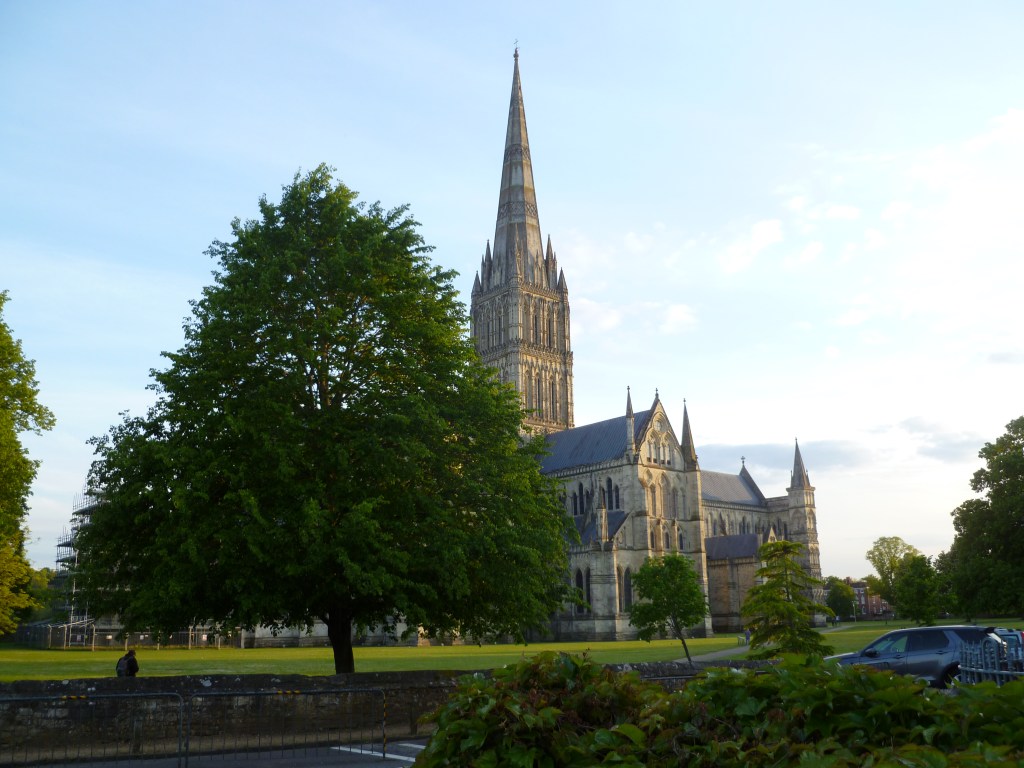
England’s cathedrals are usually centuries old; their architecture grand, their spires soaring, their furnishings elaborate. But these are not the features that remain with me after a visit to these centres of Christian worship. I tend to remember quirks and connections (especially connections to books I’ve read).
In this occasional series on UK cathedrals, I’ll share the memories that linger long after my visit. From Salisbury Cathedral, it is the flower festival and the omnipresent scaffolding. It’s also a book that links the new cathedral in central Salisbury to the previous one at Old Sarum on the city’s outskirts.
Salisbury Cathedral – Facts and Figures
Website: Salisbury Cathedral
Name: Cathedral of St Mary (Church of England Diocese of Salisbury) Date: replacing the original 11th century cathedral at Old Sarum, the ‘new’ cathedral’s foundation stones were laid in 1220
Location: West Walk, Salisbury, Wiltshire, SP1 2EF
Architecture: Gothic (Early English)
Admission charge: yes (entry for worship and prayer is free of charge); tickets are cheaper if you book in advance
Tours: a range of tours (some seasonal only) is covered by the admission price including ‘Meet the Masons’, family tours, and stained glass window tours; a ‘Behind the Scenes’ tour is available at an additional cost
Café: food is served in the Bell Tower Tea Rooms (open March–September) and the Refectory Restaurant

Flower Festival
My first visit to Salisbury Cathedral was unexpected. Not that I was surprised to find myself in the church but, when I arrived, the cathedral nave was awash with flowers. Dozens of flower arrangers from churches across Salisbury Diocese milled about, apron pockets stuffed with secateurs, florists’ wire and rolls of twine. Buckets of water, overflowing with blooms, sloshed about the floor.
I had unwittingly arrived a few days before the annual Flower Festival. Watching the vibrant preparations for the festival mitigated my disappointment at being unable to visit most areas of the cathedral.
(Check the cathedral website for the date of the flower festival. It is usually held in the second week of May.)
Several years after my curtailed trip, I made another attempt to see the cathedral.
Scaffolding
My second visit to Salisbury coincided with a stay at Sarum College, just a minute’s walk from the cathedral. This time, there were no special events in progress and I could wander at will.
Salisbury Cathedral boasts the largest cathedral close in the UK measuring some 32 hectares (80 acres). It is also notable for several other features: the tallest spire (123m) in the UK, the home one of the four surviving copies of the original Magna Carta, and the setting for the blazingly blue Prisoners of Conscience stained glass window.
But, roaming the close, I couldn’t fail to notice a not-so-unique feature of the cathedral – the presence of scaffolding. Due to the cathedral’s age, restoration projects are continuous. As someone sagely noted: ‘It wouldn’t be England without a bit of scaff.’
The cathedral website provides details of Salisbury’s current restoration projects.

Old Sarum
The current cathedral replaces an earlier one that stood at Old Sarum, some 5 kms north of the city of Salisbury. The original cathedral was created in 1075 and extended early in the 12th century before being abandoned a century or so later when the new cathedral was begun.
From the centre of Salisbury, it’s an easy bus ride followed by a short walk to reach Old Sarum. (The site is now managed by English Heritage.)
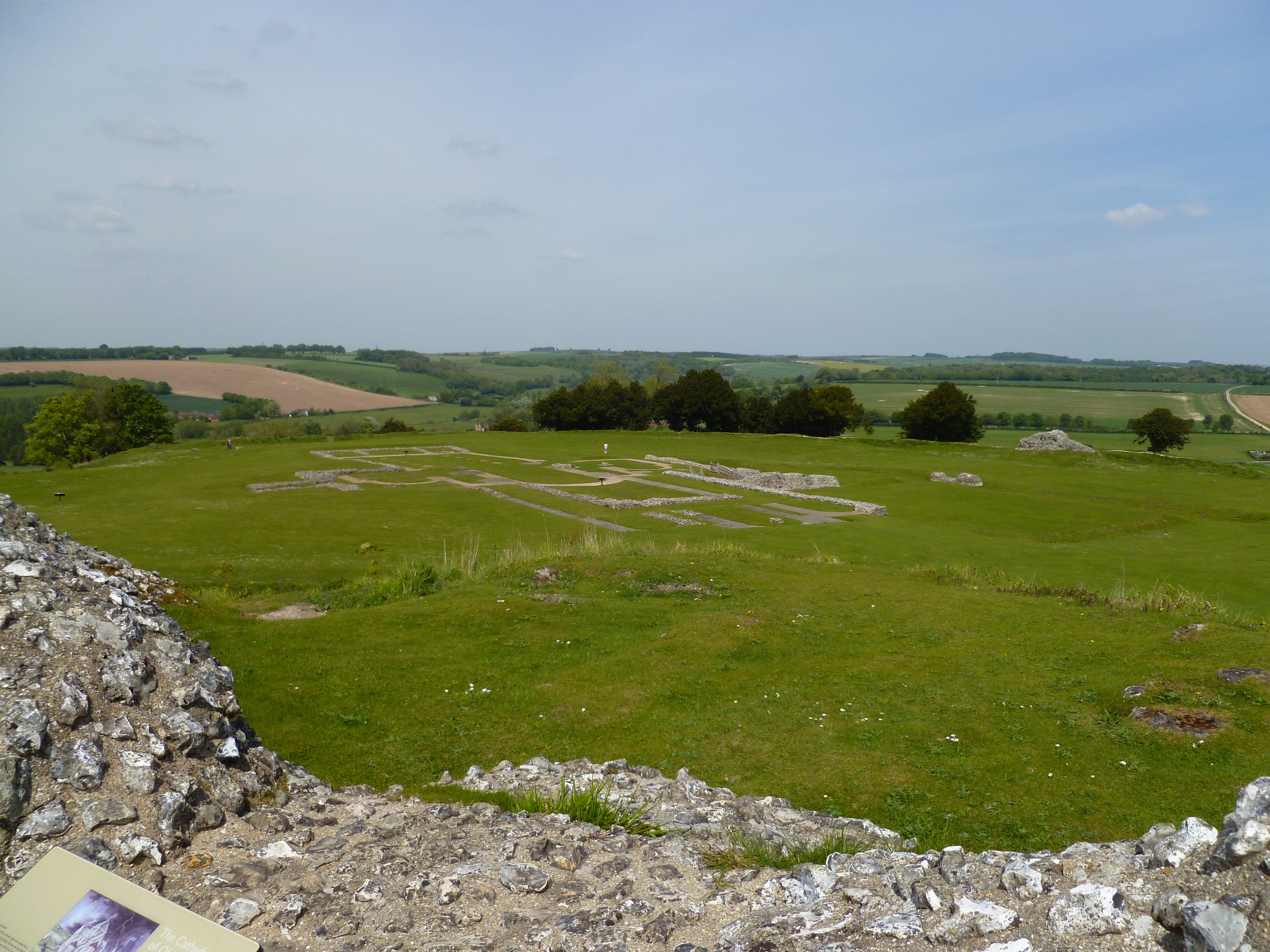
My interest in visiting both Old Sarum and the new cathedral was kindled years ago when I read Edward Rutherford’s Sarum, an epic historical novel that spans the period from the last Ice Age, through the construction of Stonehenge and the establishment of an Iron Age fort at Old Sarum, on into the Norman period with the building of Old Sarum’s cathedral, and then the building of Salisbury’s towering St Mary’s Cathedral. (Rutherford’s novel ends in the late 20th century when the new cathedral’s spire is in dire need of repair.)
Edward Rutherford’s Sarum

In Sarum, Rutherford brings to life the complex and painstaking work of the cathedral’s stonemasons.
This is how he describes these skilful craftsmen:
‘There were all kinds of mason – hewers, carvers, men who laid the stones, others who set the tracery; there were turners who used their lathes to polish the marble; bench masons at their tables, who fashioned hundreds of capitals and bosses that would be needed to seal and decorate the masonry of the mighty structure. There was the place on the floor where the complex arrangements of pillars could be drawn full size. There were stacks of wooden templates that were cut to give the mason his exact cross-sections when he carved the stone.
‘All these things a stonemason should thoroughly understand if were ever to be master of his craft.’
Reading the novel, I could imagine the cathedral rising, stone by stone, on the edge of the Salisbury Plain, and I could picture each mason’s mark inscribed on those stones – a mark that was ‘not only a signature’ but ensured the mason ‘would be correctly paid for each work he contributed to the cathedral’.
Walking the cathedral grounds, looking through the web of scaffolding, I paused in gratitude for those who had laboured across generations, glad they had left their mark.
Other posts in this occasional series include Winchester Cathedral, Truro Cathedral and St Magnus Cathedral, Kirkwall. Future posts will look at the cathedrals of Exeter, Ely and Southwark.
Links and Sources
- Salisbury Cathedral
- Sarum College
- English Heritage, ‘Old Sarum’
- Sarum by Edward Rutherford
Photo Credits
Photos by the author. This blog is licensed under a Creative Commons Attribution-NonCommercial-NoDerivatives 4.0 International License. Photos are free to use and share, but please attribute and link back to the blog.





 Thoughts from an Idle Hour
Leave a comment