

England’s cathedrals are usually centuries old; their architecture grand, their spires soaring, their furnishings elaborate. But these are not the features that remain with me after a visit to these centres of Christian worship. I tend to remember quirks and connections.
In this occasional series on UK cathedrals, I’ll share the memories that linger. From Winchester Cathedral, it’s the bells above my head and the memorial stones beneath my feet.
Winchester Cathedral – Facts and Figures
Website: Winchester Cathedral
Official name: Cathedral Church of the Holy Trinity, Saint Peter, Saint Paul and Saint Swithun (Church of England Diocese of Winchester)
Date: the ‘new’ cathedral (replacing the Old Minster, c.662) was begun in 1079 and consecrated in 1093
Location: 9 The Close, Winchester SO23 9LS
Architecture: Romanesque, Norman, Gothic
Admission charge: yes (entry for worship and prayer is free of charge)
Tours: a one-hour tour is included with admission price; specialised tours also available
Café: open daily, tucked behind a flint and brick wall, and incorporating a walled garden
Prayers: conducted on the hour for a brief period; visitor consideration requested
The Cathedral Bells
The bells of the cathedral entered popular music culture in 1966 when songwriter Geoff Stephens penned the lyrics to ‘Winchester Cathedral’. Sung originally by Stephens’ New Vaudeville Band, the song blames the silence of the cathedral bells for the loss of a girlfriend:
Winchester Cathedral, you’re bringing me down
You stood and you watched as my baby left town
You could have done something
But you didn’t try
…
She wouldn’t have gone far away
If only you’d started ringing your bell
Alas, the cathedral bells remained silent and the young woman departed.

By way of contrast, the bells in Tracy Chevalier’s A Single Thread ring loud and long. In Chevalier’s novel, protagonist Violet, one of England’s ‘surplus women’ in the aftermath of World War I, leaves her bleak existence in Southampton in 1932 and makes for Winchester. There she joins the small circle of cathedral embroiderers and also meets bellringer Arthur. As Violet’s friendship with Arthur grows so too does her curiosity about the cathedral bells and the art of bellringing.
If the 1960s-era bellringers of Stephens’ time had begun a full peal when the fleeing lass was contemplating her departure, would she have stayed? She would certainly have had plenty of time to reconsider her inclination to leave. As Arthur explains to Violet in A Single Thread: ‘A peal always takes over three hours, and goes through over five thousand changes … without stopping.’
In Arthur’s time, the cathedral housed 12 bells. That number affords the bellringers 479,001, 600 possible variations. The same number of bells was still present when Stephens wrote ‘Winchester Cathedral’ but, soon after the song’s release, a thirteenth bell was added to the peal. Three further bells have been added in the decades since.
Watch the bellringers and hear the cathedral’s 16 bells ringing Rounds on Sixteen.
Jane Austen
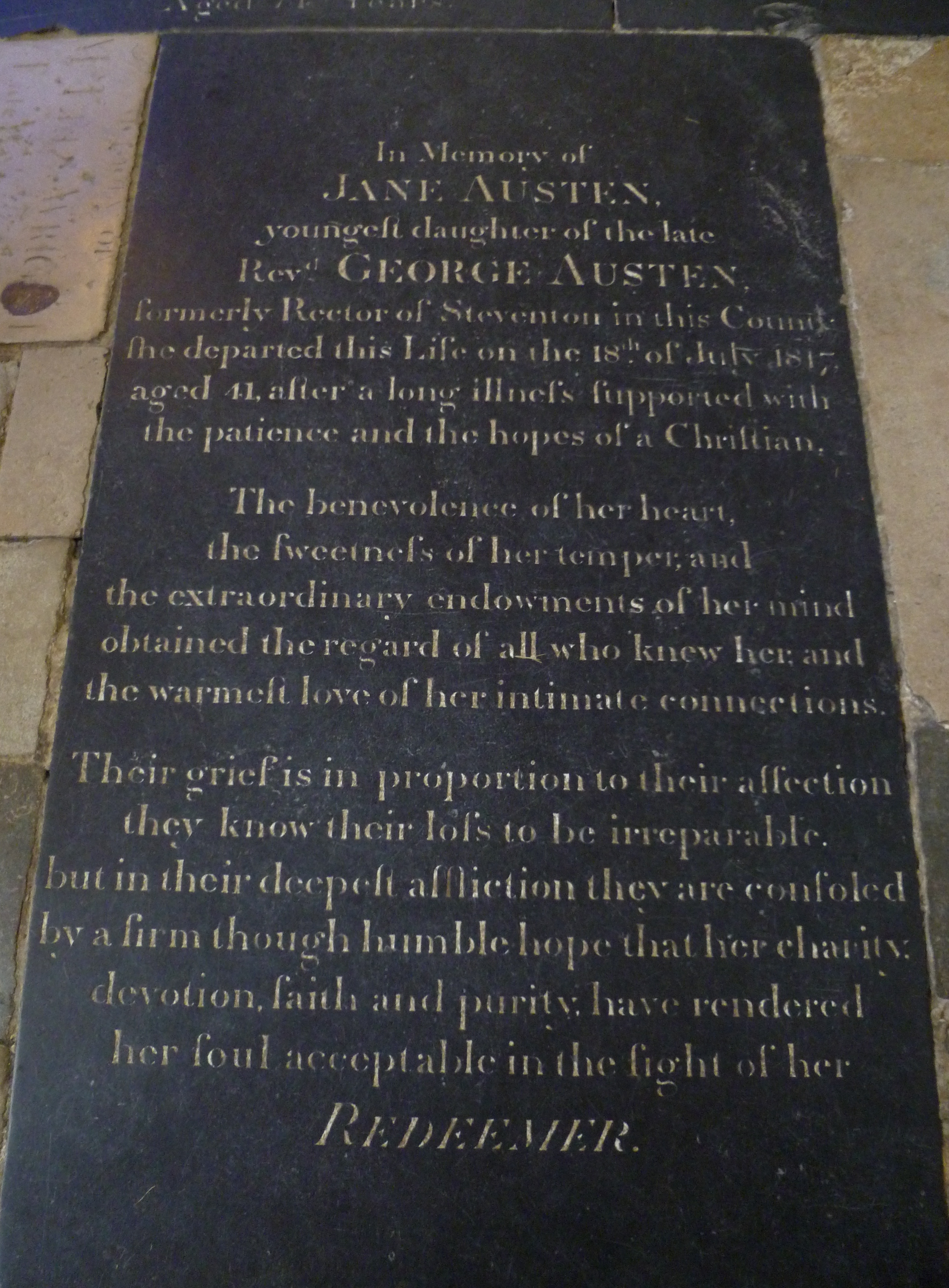
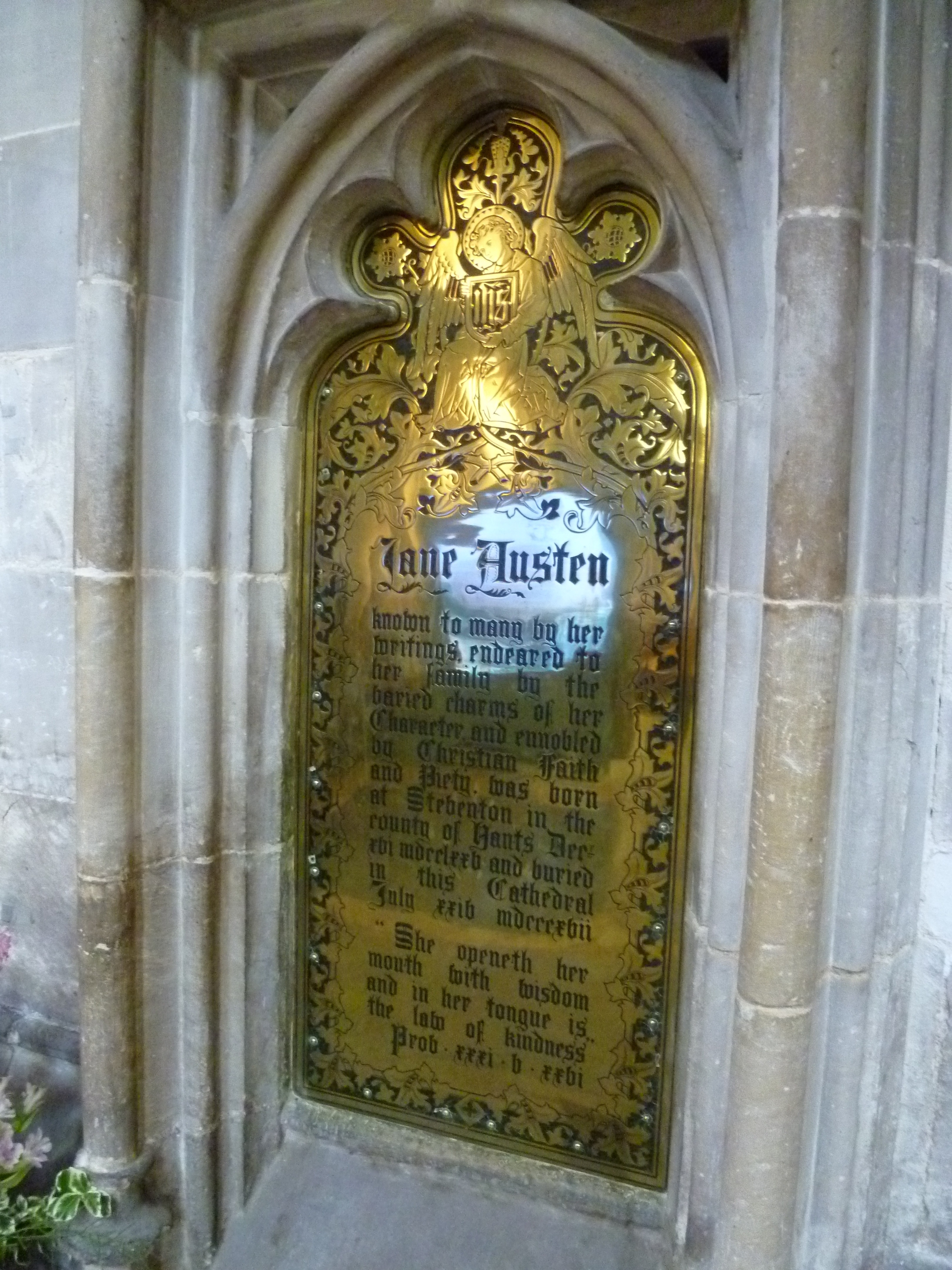
Popular songs and historical novels aside, Winchester Cathedral’s greatest claim to literary fame is as the burial place of novelist Jane Austen. Austen spent the final months of her life in Winchester and was buried in the cathedral on 24 July 1817, six days after her death.
Austen’s memorial stone, placed above her grave in the north aisle reads, in part: ‘The benevolence of her heart, the sweetness of her temper, and the extraordinary endowments of her mind obtained the regard of all who knew her, and the warmest love of her intimate connections.
Those familiar with the 1995 BBC TV adaptation of Austen’s Pride and Prejudice will recognise a connection with another writer buried in the cathedral – Izaak Walton, author of The Compleat Angler.
In Austen’s original text, when Elizabeth Bennet and her Aunt and Uncle Gardiner unexpectedly encounter Mr Darcy on his fine estate in Pemberley, the conversation between the two men turns to fishing. Mr Darcy invites Mr Gardiner to fish as often as he chooses while in the neighbourhood, even offering to supply his visitor with tackle and ‘pointing out those parts of the stream where there was usually most sport’. When Andrew Davies adapted the novel for the screen, he re-scripted Austen’s prose to create this dialogue between the gentlemen:
‘Mr. Gardiner, you’re perhaps an angler? A complete angler?’
‘Mr. Walton’s book is my Bible.’
‘While you continue in the neighbourhood, you must do all the fishing you can. I can supply you with any tackle you may need.’
Today, Austen’s remains dwell underfoot in the north aisle of the cathedral’s nave; Walton’s are entombed on the southern side in the church’s Silkstede Chapel.
As I leave the cathedral, I think of Elizabeth Bennet’s chance meeting with Mr Darcy as she roams the grounds of the Pemberley estate. Equally, one never knows what one might encounter when wandering in a cathedral.
Other posts in this occasional series include Salisbury Cathedral, Truro Cathedral and St Magnus Cathedral, Kirkwall. Future posts will look at the cathedrals of Exeter, Ely and Southwark.
Links and Sources
- Winchester Cathedral website
- ‘Winchester Cathedral’, lyrics by Geoff Stephens
- Winchester Cathedral’s bells, Dove’s Guide for Church Bell Ringers
- Central Council of Church Bell Ringers
- A Single Thread by Tracy Chevalier (Harper Collins)
- Pride and Prejudice by Jane Austen (Allen & Unwin)
- The Compleat Angler by Izaac Walton (Oxford University Press)
Photo Credits
Photos by the author. This blog is licensed under a Creative Commons Attribution-NonCommercial-NoDerivatives 4.0 International License. Photos are free to use and share, but please attribute and link back to the blog.





 Thoughts from an Idle Hour
Leave a comment